On this page
- The one rule the order of precedence comes from
- The US flag with state, city, and organizational flags
- The US flag with flags of other nations
- The military service flags, in order
- Where the POW/MIA flag goes
- Indoor displays, auditoriums, and stages
- A checklist for an organizational display
- Common questions
- Related reading
- Sources
One flag is easy. The moment you add a second, you are making a statement about rank whether you meant to or not. Get the order wrong at a federal building, a military installation, or an event with international guests and someone will notice.
The rules are in section 7 of the US Flag Code, plus service tradition for the military flags. Here is the whole picture.
Together those rules are called the flag order of precedence, and they cover every display you are likely to build: one pole, a row of poles, a stage, a parade.
The one rule the order of precedence comes from
The position of honor is the flag’s own right.
A flag has a right and a left the way a person does, and it faces the viewer. So the flag’s own right is your left when you are looking at it. If you remember nothing else, remember that the place of honor is on your left as you face the display.
Every arrangement below is an application of that single idea. Find the flag’s own right, and the rest of the order of precedence follows.
The US flag with state, city, and organizational flags

On the same halyard
The US flag goes at the peak. Always. State, city, and organizational flags hang below it on the same rope. The US flag is hoisted first and lowered last.
On separate poles of equal height
The US flag takes the position of honor, its own right, which is the left end of the row as you face it. Raised first, lowered last.
In a group or a semicircle
The US flag goes at the center and at the highest point.
In a line for a parade or a color guard
The US flag is on the marching right, or in front of the center of the line.
On crossed staffs against a wall
The US flag goes to its own right, and its staff crosses in front of the other flag’s staff.
The order after the US flag
The customary domestic order is: the flag of the state you are in, then other state flags (by order of admission to the Union, or alphabetically, but pick one and stay consistent), then county and city flags, then military flags, then organizational and corporate flags. Corporate flags fly below and after everything governmental.
That sequence is the domestic order of precedence. Write it down once, post it where the halyards are, and nobody has to guess on a Monday morning.
We stock state and territory flags for all fifty states plus the territories, and country flags for more than 195 nations.
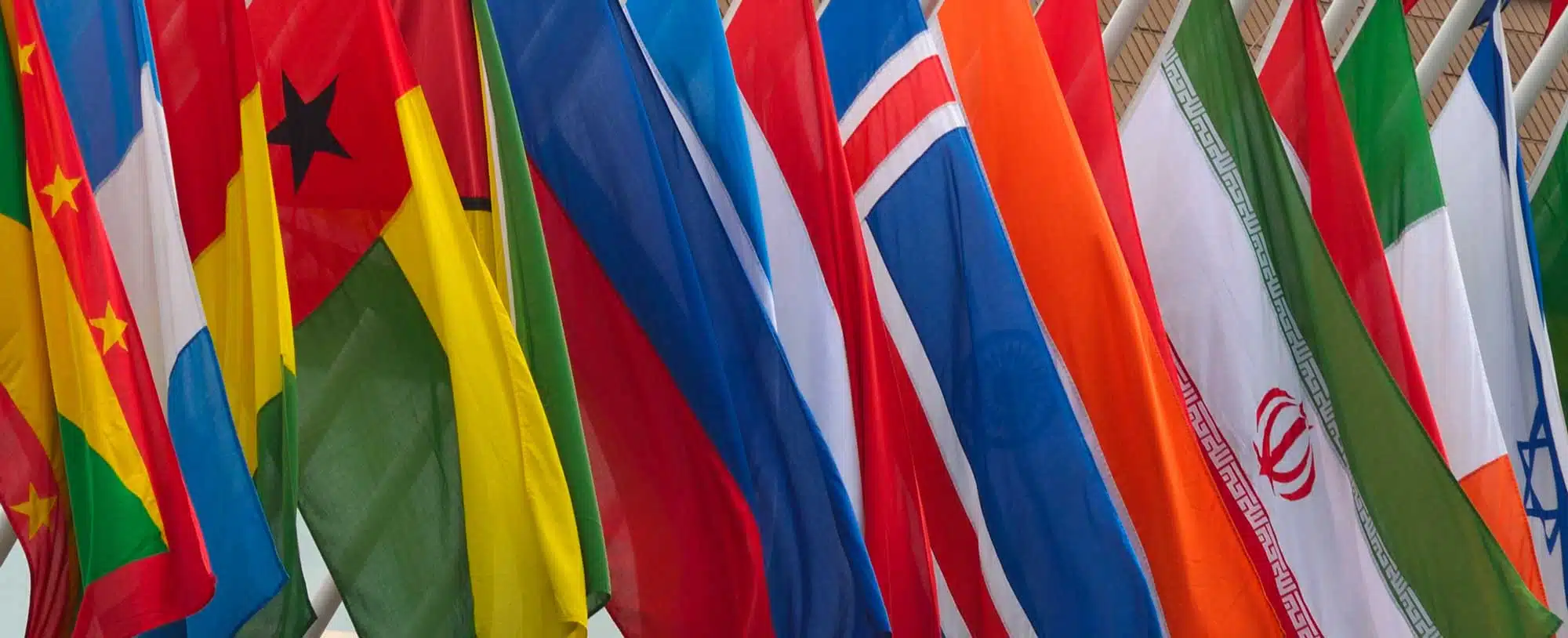
The US flag with flags of other nations
This is the arrangement organizations get wrong most often, and the mistake is always the same: they try to make the US flag bigger or higher out of respect.
Equal height, equal size
The Flag Code is explicit. When flags of two or more nations are displayed, they are flown from separate staffs of the same height, and the flags should be of approximately equal size. International usage forbids displaying one nation’s flag above another’s in time of peace.
No taller pole for the home team. No larger flag. If you are hosting a delegation, a trade partner, or a sister city, equal height and equal size is the courtesy, and it is the rule.

The order you do control
In the United States, the US flag takes the position of honor at the flag’s own right, the observer’s left, and other national flags follow in English alphabetical order of the country name. That alphabetical convention comes from UN practice and is standard for international displays.
The military service flags, in order

Service flag precedence follows seniority and tradition, not the organization chart. The current order:
- United States Army
- United States Marine Corps
- United States Navy
- United States Air Force
- United States Space Force
- United States Coast Guard

Why the Marine Corps comes before the Navy
The Marine Corps sits organizationally inside the Department of the Navy, so the order looks backwards. Precedence follows service seniority and 19th-century protocol, not the modern org chart. The Defense Logistics Agency has published an article devoted entirely to explaining this, because it comes up constantly.

The Coast Guard exception
In peacetime the Coast Guard is part of the Department of Homeland Security and its flag is displayed last. In wartime, when the Coast Guard operates under the Department of Defense, its flag moves up to fly after the Navy and before the Air Force.

Space Force
Established in 2019, it slots in after the Air Force and before the Coast Guard. If you are working from a printed reference older than 2019, it will not be in there.
We carry all six branches, plus general and admiral officer rank flags, in grommet, fringe, and pole hem finishes. See military flags and military flag sets.
Where the POW/MIA flag goes
Federal law directs the POW/MIA flag to be displayed at specified federal locations on designated days. Where a US flag and a POW/MIA flag fly on the same pole, the POW/MIA flag goes directly below the US flag and above any other flag. On separate poles, it takes the position immediately after the US flag and before state flags.

See POW/MIA flags.
Indoor displays, auditoriums, and stages

Section 7 handles this specifically, and the phrasing trips people up.
When displayed from a staff in a church, auditorium, or public assembly, the US flag holds the position of superior prominence, in front of the audience and to the speaker’s own right as the speaker faces the audience. Any other flag goes to the speaker’s left. If the flag is displayed elsewhere in the hall rather than on the platform, it goes to the audience’s right.
Put simply: on the stage, the US flag is on the speaker’s right hand. From the seats, that is your left.
Indoor flags are typically pole hem or fringed, on indoor flagpoles with a floor stand. Our anatomy of a flag post covers the difference between the finishes.
A checklist for an organizational display
- Is the US flag at the peak, at the center and highest point, or at the observer’s left end of the row?
- If foreign flags are present, are all poles the same height and all flags roughly the same size?
- Is the US flag raised first and lowered last, every day?
- Do all the flags in the display match each other in size and material, so one is not visibly newer than the rest?
- Is anything in the display worn enough to need repair or retirement?
Common questions
Related reading
- US flag etiquette: what the Flag Code actually says
- Flying a flag at half-staff: who orders it, and how to do it right
- Choose the right size flag for your flagpole
Setting up a multi-flag display for an agency, a campus, or a headquarters? Tell us what you are trying to do and we will help you spec it.
Sources
- 4 U.S.C. § 7, Position and manner of display · Office of the Law Revision Counsel · uscode.house.gov
- Flag Precedence: Why the Marine Corps is Senior to the Navy · Defense Logistics Agency · dla.mil
- The History Behind Our Nation’s Military Service Flags · U.S. Department of Veterans Affairs · va.gov
- 4 U.S.C. Chapter 1, The Flag · Office of the Law Revision Counsel · uscode.house.gov


