On this page
- The UN flags on First Avenue, and when they fly
- What the UN flags refuse to say
- Inside the hall, the order is drawn by lot
- At the podium, Brazil goes first
- Change the name, move the flag
- The same rule is in the US Flag Code
- If you fly flags of more than one nation
- What a flag line is for
- Common questions
- Related reading
- Sources
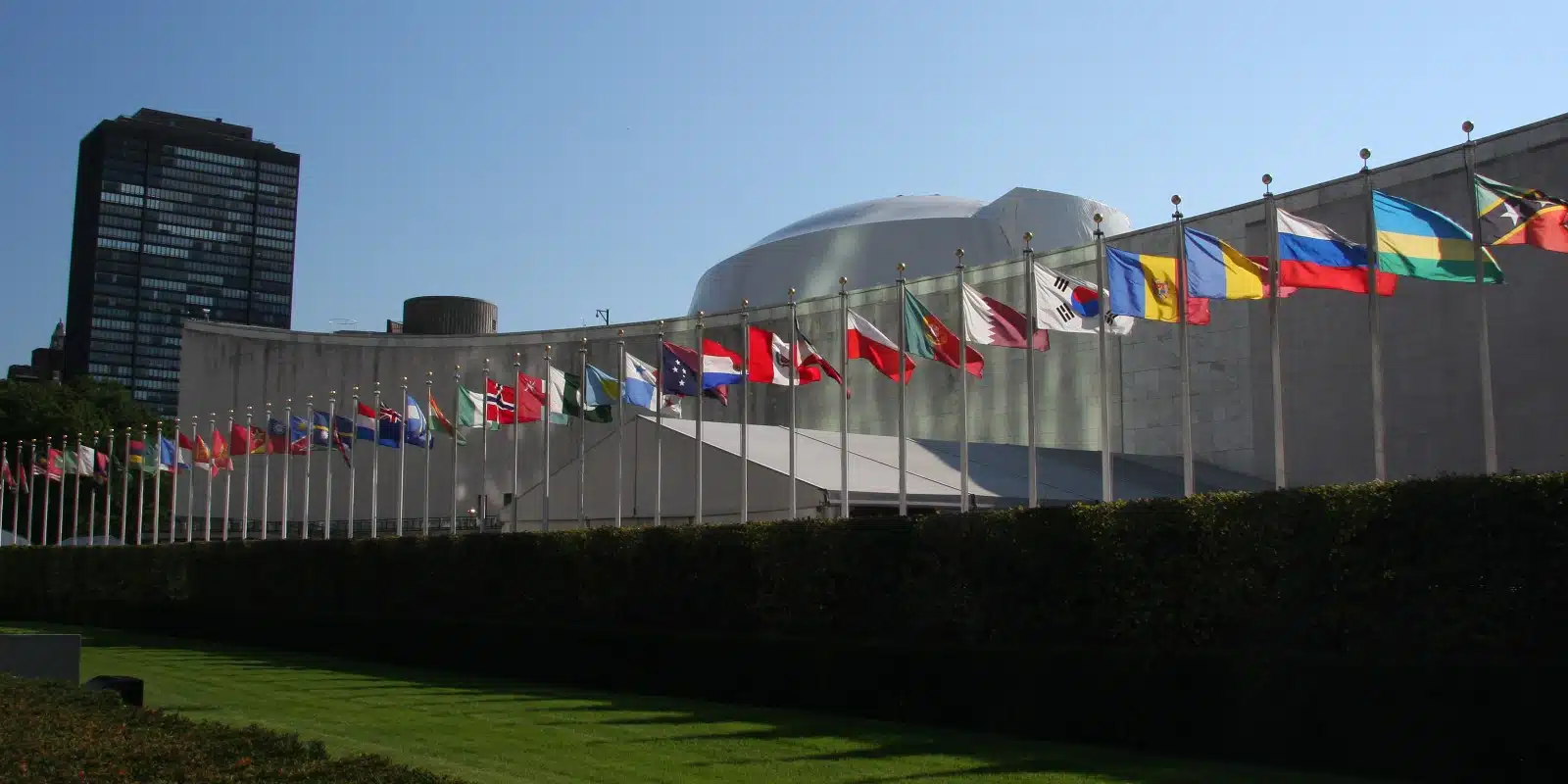
Walk up First Avenue this week and you pass 195 national flags in six blocks. Every pole is the same height. Every flag is the same size. Not one of them is ranked.
That is the plainest thing the United Nations says about people, and it says it in fabric and aluminum rather than in a speech. The 81st session of the General Assembly is meeting under the theme “Restoring trust, managing transformation: A United Nations that delivers for all.” The flag line has been making that argument every morning for decades, without a microphone.
High-level week runs 18 to 28 September 2026, with the general debate from 22 to 28 September. Around 120 leaders are in New York for it.
The UN flags on First Avenue, and when they fly
The row runs from 42nd Street to 48th Street, six city blocks. One pole for each of the 193 member states, plus two added in 2015 for the non-member observer states, the Holy See and the State of Palestine. The UN flags are arranged alphabetically north to south, Afghanistan to Zimbabwe.
On an ordinary weekend the UN flag goes up alone from 8am to 4pm. High-level week is the exception. For these ten days the UN flags stay up around the clock. Walk past at two in the morning during the general debate and all 195 are flying, lit, in the order they were in at noon. The one week of the year with the most heads of state in the building is the one week the flags never come down.
What the UN flags refuse to say
Alphabetical order looks like the absence of a decision. It is the opposite. It is a decision to refuse every other order that was available.
The UN flags could have been ranked by population, by budget contribution, by the date each country joined, by Security Council seniority. Every one of those is real data. Every one would also have been a statement, remade every morning at 8am, about who matters more. Alphabetical order is the only arrangement that says nothing. Afghanistan is not first because Afghanistan earned it. Afghanistan is first because of the letter A.

That matters because the institution behind the UN flags is not flat. Five countries hold a permanent Security Council seat with a veto. Budget shares vary by orders of magnitude. The UN has hierarchy everywhere except on First Avenue, and that looks deliberate. The construction carries the same message: every member flies the same size flag from the same height of pole on the same schedule.
The Charter of the United Nations begins with three simple words: “We the Peoples.” Not “We the Powerful.” Not “We the Victorious.” “We the Peoples.” All of us, bound by a single conviction: that we are safer, stronger and more human when we stand together.
António Guterres, Secretary-General of the United Nations, at the commemoration of the signing of the UN Charter, 26 June 2026
Read that against the row on First Avenue and the row stops being decoration. “Not we the powerful” is a sentence. Six blocks of poles cut to one length is the same sentence, built so that it cannot be argued with.
Inside the hall, the order is drawn by lot
The UN flags outside are fixed. The seats inside are not, and the gap between the two systems is the interesting part.

On the day the General Assembly elects its President, the Secretary-General draws lots to decide which delegation takes the first seat, the one at the right end of the front row as you face the podium. Everyone else is seated in English alphabetical order from there, wrapping around.
So the front row changes every year. This session it is Morocco. Last session, Niger. Before that, Yemen. Two ordering systems thirty feet apart, both built to stop any country acquiring a permanent claim on the best spot in the room.
At the podium, Brazil goes first
The third system is the speaking list. In the Assembly’s early years nobody wanted to open the general debate. Brazil did it, more than once, and the habit hardened into tradition. Brazil still opens. The United States speaks second as the host country. After that the order runs on level of representation, geographic balance, and when each request came in.
An accident became protocol because it solved a problem and nobody wanted to reopen it. Flag protocol is full of this. The US flag goes to the observer’s left in a display because the flag has a right and a left the way a person does, and the position of honor is the flag’s own right. That rule is inherited, and it holds because everyone inherited it together.
Change the name, move the flag
Alphabetical order has a consequence people rarely think through. The UN flags are sorted by name, so a new name means a new position.
Swaziland became Eswatini on 19 April 2018. In the UN list that is not a relabeling, it is a relocation, out of the S section and up into the E section, past a long stretch of countries it had stood beside for fifty years. The flag did not change. The pole did. North Macedonia’s flag was raised at UN headquarters on 15 February 2019 once the naming dispute was settled, and the same thing applied: same design, different letter, different placement.
Membership does it at a larger scale. The most recent state admitted was South Sudan, on 14 July 2011. Adding a member is not a matter of adding a pole at the end. It opens a gap in the middle and shifts everything south of it. That is the running cost of a neutral system, and it is worth paying. A hierarchy would never make you move a flagpole. It would just make you argue.
The same rule is in the US Flag Code
None of this is foreign practice. The same principle is written into US law.

Section 7(g) of Title 4 says that when flags of two or more nations are displayed they are flown from separate staffs of the same height, and the flags should be of approximately equal size. It adds that international usage forbids flying one nation’s flag above another in time of peace.
In our experience this is the most commonly broken rule in the country, and it is almost always broken out of good intentions. An organization hosting a foreign delegation wants to show respect for the US flag, so it uses a taller pole, or orders the US flag a size larger. Both are the error. The courtesy, and the rule, is equal height and equal size.
If you fly flags of more than one nation
- Separate poles, same height. If your poles differ in height you do not have a display, you have a ranking.
- Flags of approximately equal size. Buy the set together. Sizes drift when flags are replaced one at a time over several years.
- Pick an order and write it down. English alphabetical order of the country name is the standard convention, and the one the UN uses. Put it in the procedure so the next person does not guess.
- Position of honor, not the high ground. In the United States the US flag goes to its own right, the observer’s left end of the row. Position, not altitude.
- Light them if you fly overnight. The Flag Code allows 24-hour display when the flag is properly illuminated. That is the same exception the UN flags are using this week.
The full domestic ordering, including where state, city, corporate and military flags fall, is in our guide to the flag order of precedence.
We stock country flags for more than 195 nations and US flags in every standard size and finish, and we supply agencies and institutions across the National Capital Region that host international visitors. Building a multi-flag display and want a second set of eyes on it? Tell us what you are trying to do.
What a flag line is for
We make flags for a living, so we think about this more than most people do. A flag is cloth on a rope. It holds no opinion of its own. Everything a display says, it says through height, size, order and position, and a person chose all four.
That is why the row on First Avenue repays a close look. It is built so that no country can read anything into where it stands, and that is not free. Admit a member and the poles shift. Change a country’s name and its flag moves out of one letter and into another. Nobody pays that bill for decoration. They pay it because the alternative is a ranking, and a ranking is an argument that never ends.
The same choice is available at two poles in front of a school, a firehouse, a plant or a city hall. Same height, same size, an order written down before anyone asks. It costs almost nothing, and it says the thing worth saying, which is that the people on the other end of that flag count as much as you do.
Common questions
Related reading
Sources
- High-level Week 2026 · United Nations · un.org
- Flagging the United Nations · United Nations · un.org
- Flagging the United Nations · UN News · news.un.org
- How are UN Member States seated in the General Assembly? (A/RES/71/323) · Dag Hammarskjöld Library · ask.un.org
- Key facts to know about the UN General Assembly · UNRIC · unric.org
- Current UN Member States · Dag Hammarskjöld Library · research.un.org
- So Proudly They Wave: United Nations · Flags of the World · crwflags.com
- 4 U.S.C. § 7, Position and manner of display (subsection (g)) · Office of the Law Revision Counsel · uscode.house.gov
- At the UN General Assembly, a world in flux · NPR · npr.org
- Remarks at the commemoration of the signing of the UN Charter (26 June 2026) · Secretary-General of the United Nations · transcripts.un.org
Image credits
- Flags along the General Assembly building on First Avenue · Photo by Yerpo · Wikimedia Commons · CC BY-SA 3.0 · cropped
- The General Assembly Hall between sessions · Photo by Lusi Lindwurm · Wikimedia Commons · CC BY-SA 4.0 · resized


Leave A Comment