
On this page
- Who can order half-staff
- How long half-staff lasts
- The half-staff dates that come around every year
- The two steps almost everyone skips
- Half-staff or half-mast?
- When the flag cannot be lowered
- How to know whether a half-staff order is in effect
- If you fly flags for an organization
- Common questions
- Related reading
- Sources
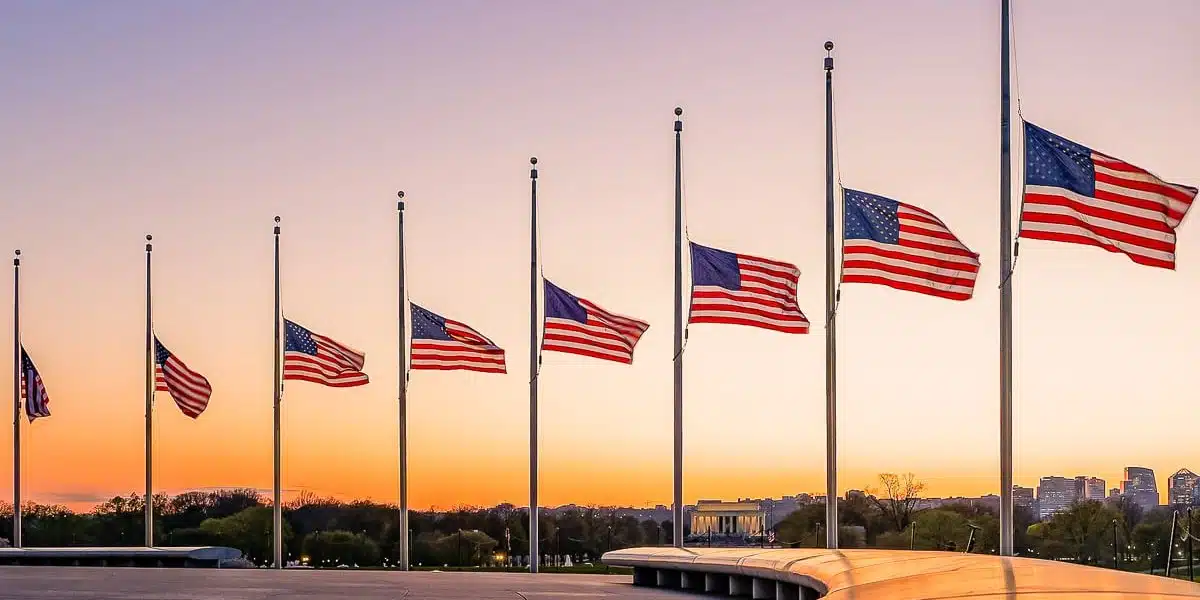
Half-staff is the piece of flag protocol most organizations have to get right in public, on short notice, often on a day when nobody is thinking clearly. It is also the one where the rules are more specific than people expect.
Here is the whole thing: who can order half-staff, how long it lasts, the two mechanical steps almost everyone skips, and how to find out whether an order is in effect right now.
Who can order half-staff
Two authorities, and only two.
The President orders half-staff nationally, for the death of principal figures of the United States government and for national days of mourning.
A state governor (and the Mayor of the District of Columbia, with equivalent authority for the District) may order half-staff within that jurisdiction for the death of a present or former official of the state, a member of the Armed Forces from that state who dies in active duty service, or a first responder who dies in the line of duty.
That is the complete list. A company, a school, a homeowners association, or a private citizen has no authority to order it for anyone. What people usually mean when they ask about this is whether they may lower their own flag as a private gesture, and nothing stops them. It just is not a half-staff order, and it does not obligate anyone else.
The distinction matters more than it sounds. A building that drops to half-staff on its own is making a statement other buildings did not agree to make, and on a campus or a business park it usually starts a phone call. If you want to mark a loss that no proclamation covers, say so in writing on the door or the website rather than on the pole.

How long half-staff lasts
Section 7(m) of Title 4 sets fixed durations for deaths of officials. These four are the ones that come up most, and they are the reason a half-staff period can run a month for one death and two days for another.
| Official | Half-staff duration |
|---|---|
| President or former President | 30 days from the date of death |
| Vice President, Chief Justice or retired Chief Justice, Speaker of the House | 10 days from the date of death |
| Associate Justice, Cabinet Secretary, former Vice President, or a state Governor | From the date of death until interment |
| Member of Congress | The day of death and the following day |
A presidential proclamation can extend or modify these. When it does, the proclamation is the controlling instruction, not the table.
Two practical notes. “Until interment” has no fixed end date, so a governor’s death can keep flags at half-staff for an unpredictable stretch, and somebody has to be watching for the funeral date. And a 30-day period will almost always overlap something else, a scheduled event, a grand opening, a graduation. The flag stays down. The event works around it.
The half-staff dates that come around every year
Two are written directly into the Flag Code.
- Peace Officers Memorial Day, May 15. Half-staff, unless it falls on Armed Forces Day.
- Memorial Day, the last Monday in May. Half-staff until noon, then raised to the top of the staff for the rest of the day.
Memorial Day catches people out every year, because it is the only one that changes position at a set hour. Put the noon raise on a calendar with an alarm. A flag left down all afternoon on Memorial Day is the single most common error in the country.

Several other observances that people assume are automatic are actually proclamation-driven. Patriot Day (September 11) works under a separate statute that requests the President to issue an annual proclamation calling for half-staff. National Pearl Harbor Remembrance Day (December 7) and the National Fallen Firefighters Memorial Service observance work the same way. In practice the proclamation is issued every year, so the flag does go to half-staff. The distinction only matters if you are writing standing procedures: cite the proclamation, not the Flag Code.
We went through this in detail for one of them in Patriot Day flag etiquette, including what the annual proclamation does and does not say.
The two steps almost everyone skips
Section 7(m) is specific about the mechanics, and this is where most installations get half-staff wrong.

- Raising. Hoist the flag briskly to the peak of the pole, pause for an instant, then lower it slowly to the half-staff position.
- Lowering. At the end of the day, raise it back to the peak, then lower it fully.
The flag never goes straight to that position and never comes down from it. Peak first, both times. It takes about ten extra seconds and it is the difference between doing it and doing it right.
Where is half-staff, exactly? The statute defines it as the position of the flag when it is one-half the distance between the top and the bottom of the staff. Not slightly lowered. Halfway.

One more thing worth checking before a half-staff day rather than during one: the halyard itself. A rope that binds at the truck turns a ten-second sequence into a five-minute problem with an audience. Run the flag to the peak and back once a season so you find the snag on an ordinary Tuesday.
Half-staff or half-mast?
The Flag Code uses only “half-staff,” and defines it. “Half-mast” is the maritime term, used aboard ships and standard in British usage. On land, on a flagpole, the American term is the one in the statute.
This is usage convention rather than a codified rule, and nobody will correct you at a funeral. But if you are writing an agency procedure or a press release, “half-staff” is the word that matches the statute.
When the flag cannot be lowered
Some flags physically cannot be lowered. A flag on a house-mounted bracket, a flag on a fixed indoor pole, and a flag on a pole with no halyard all present the same problem.

The Flag Code does not address this, so there is no official answer. The customary practice, and what we recommend, is to attach a black mourning ribbon or streamer to the top of the staff, at the base of the finial, for the duration of the mourning period. It signals the same thing and it does not require you to improvise something the Code never contemplated.
Be clear with yourself about what that is. The streamer is custom, not law. The words mourning, streamer, ribbon and crepe do not appear in the Flag Code at all. It is a respectful convention that reads correctly to the public, and it is a better answer than taking the flag down or leaving it at full staff while every pole on the street sits at half-staff.
How to know whether a half-staff order is in effect
There is no single official government status page for this, which surprises people. Half-staff orders are published where they are issued.
- National orders appear as Presidential Actions on whitehouse.gov and in the Federal Register.
- State orders are published by each governor’s office. If you fly flags for a business or institution, subscribing to your governor’s press release list is the single most useful thing you can do.
Third-party alert sites exist and many are helpful. They are not authoritative, and we would not build an agency procedure on one. They also tend to publish a national order and a single state order side by side without saying which one applies to you, which is how a building in Virginia ends up at half-staff for a Kansas proclamation.
If you are in the National Capital Region, watch three sources rather than one: the White House for national orders, your own governor’s office, and the Mayor of the District of Columbia if you operate inside DC. An order from one of the three does not bind the other two.
If you fly flags for an organization
A short standing procedure prevents most half-staff problems. Ours would say:
- Name one person responsible, and one backup.
- Subscribe both of them to the governor’s office notifications.
- Write down the peak-first, peak-last sequence and post it where the halyard is.
- Decide in advance what happens on a fixed pole, so nobody has to improvise.
- Keep a spare flag on hand. A half-staff day is a bad day to discover the flag is shredded. See how long a flag lasts.

One page is enough. The failure mode is almost never that someone read the rule and misapplied it. It is that the person who knew the rule was on leave, and the person holding the halyard had never been told.
Common questions
Related reading
- Patriot Day flag etiquette, and the half that gets left out
- US flag etiquette: what the Flag Code actually says
- Order of precedence: flying more than one flag correctly
- Anatomy of a flag: every part, named
We supply flags to federal agencies, military installations, and municipalities across the National Capital Region, and we carry US flags and military flags in every standard size and finish. If you need one quickly, call us and ask what is on the shelf.
Sources
- 4 U.S.C. § 7, Position and manner of display (subsection (m), half-staff) · Office of the Law Revision Counsel · uscode.house.gov
- 4 U.S.C. Chapter 1, The Flag · Office of the Law Revision Counsel · uscode.house.gov
- 36 U.S.C. § 144, Patriot Day · Cornell Legal Information Institute · law.cornell.edu
- 36 U.S.C. § 136, Peace Officers Memorial Day · Cornell Legal Information Institute · law.cornell.edu
- Presidential Actions · The White House · whitehouse.gov
- Frequently Asked Questions About Flag Law (R45945) · Congressional Research Service · congress.gov


