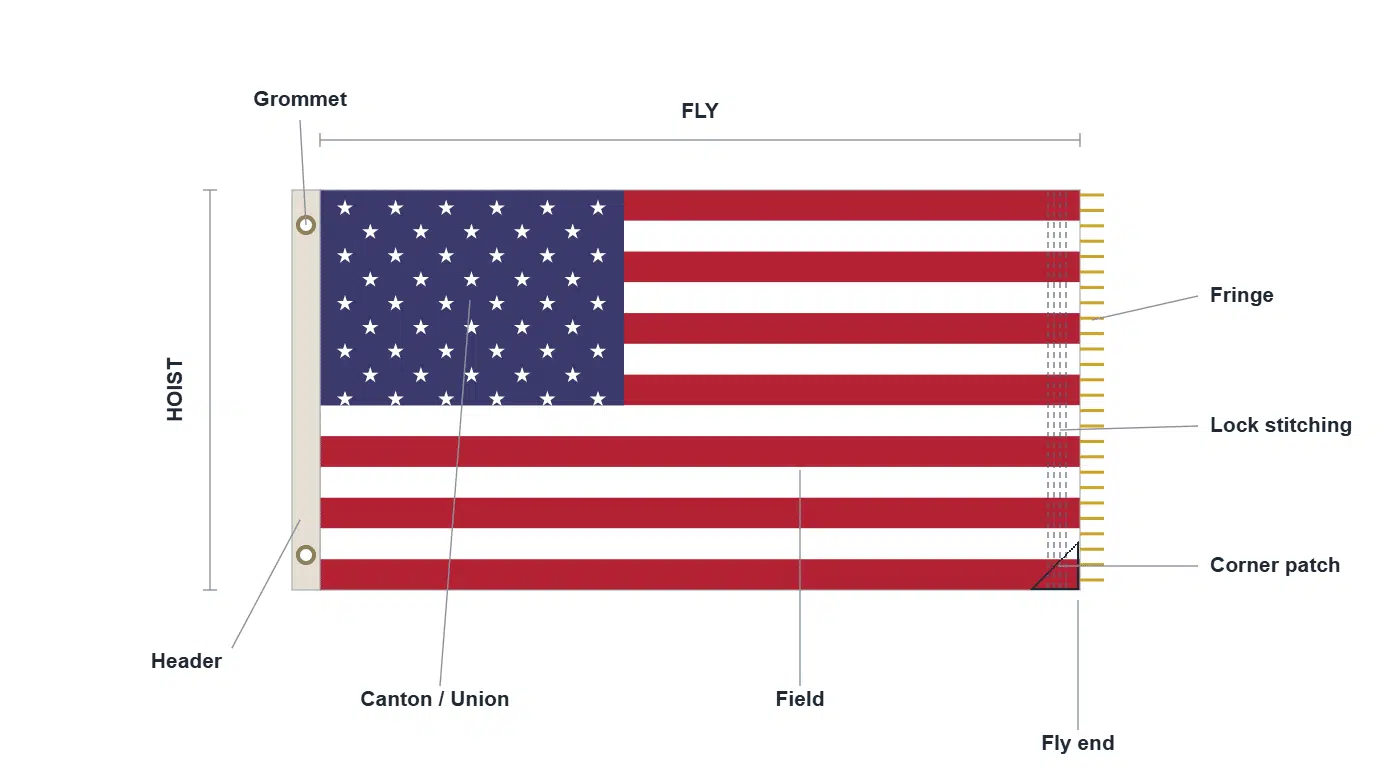
Every part of a flag has a name. There are 25 in all: 15 on the flag, 3 ways the stars are made, and 7 on the pole. This page defines all 25 parts of a flag and its pole, with a labeled illustration for each one.
On this page
The parts of a flag are grouped below by where they sit: the flag itself, then the stars, then the pole. Definitions only.
The flag itself: 15 parts
These 15 parts of a flag cover its dimensions, its face, the hoist edge that attaches to the pole, and the stitching that keeps it from shredding in wind.
Dimensions and edges
Hoist
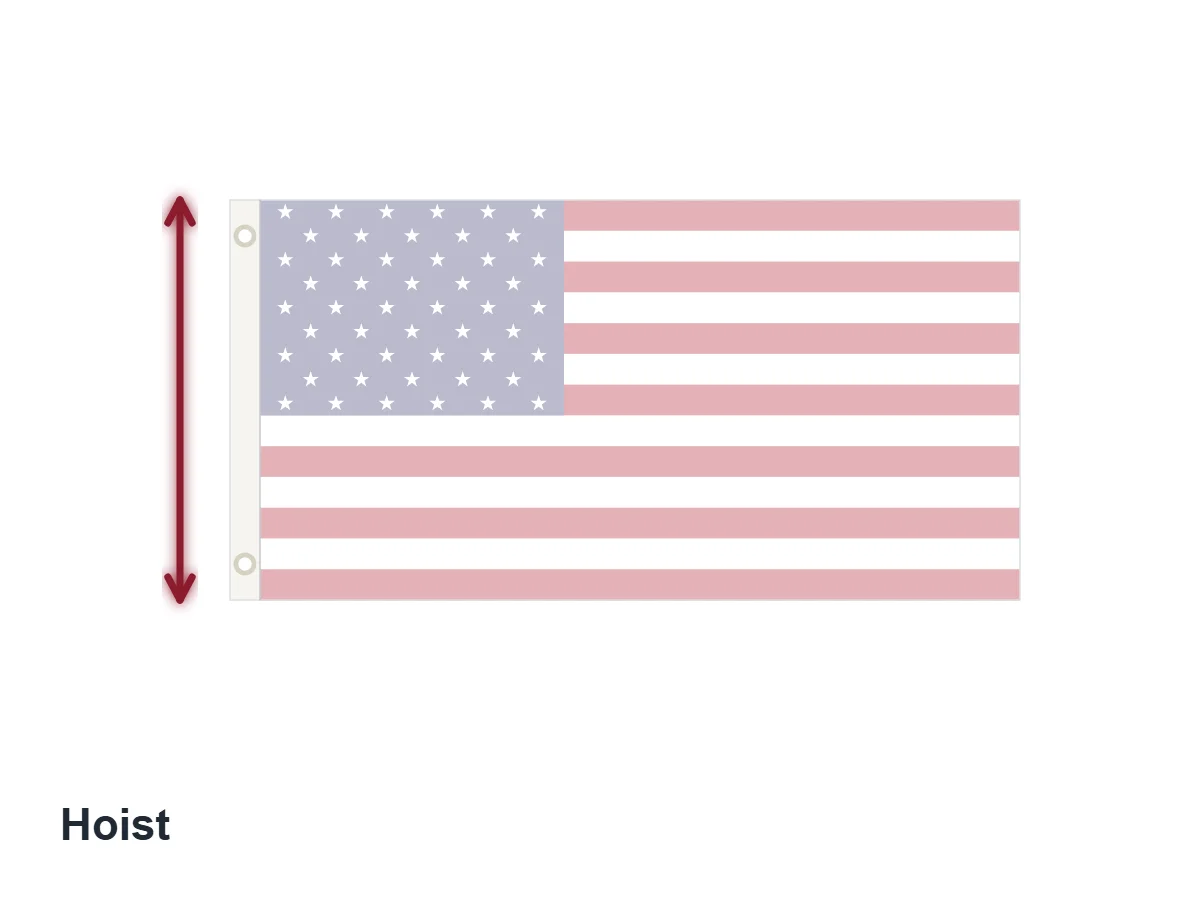
The edge nearest the pole. Also the name for the flag’s vertical dimension, and the verb for raising it. In a size such as 3′ x 5′, the hoist is the first number.
Fly
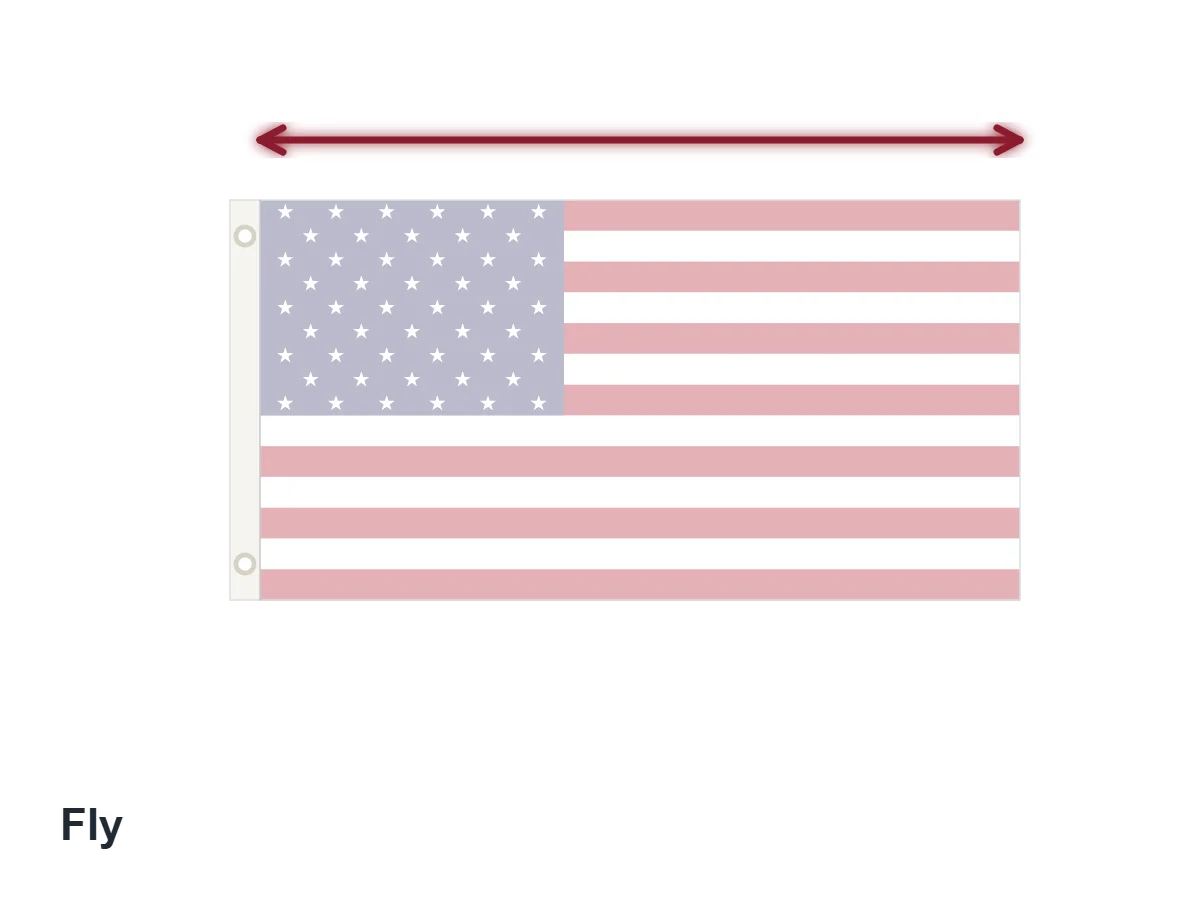
The edge farthest from the pole. Also the horizontal dimension. In 3′ x 5′, the fly is the second number.
Fly end
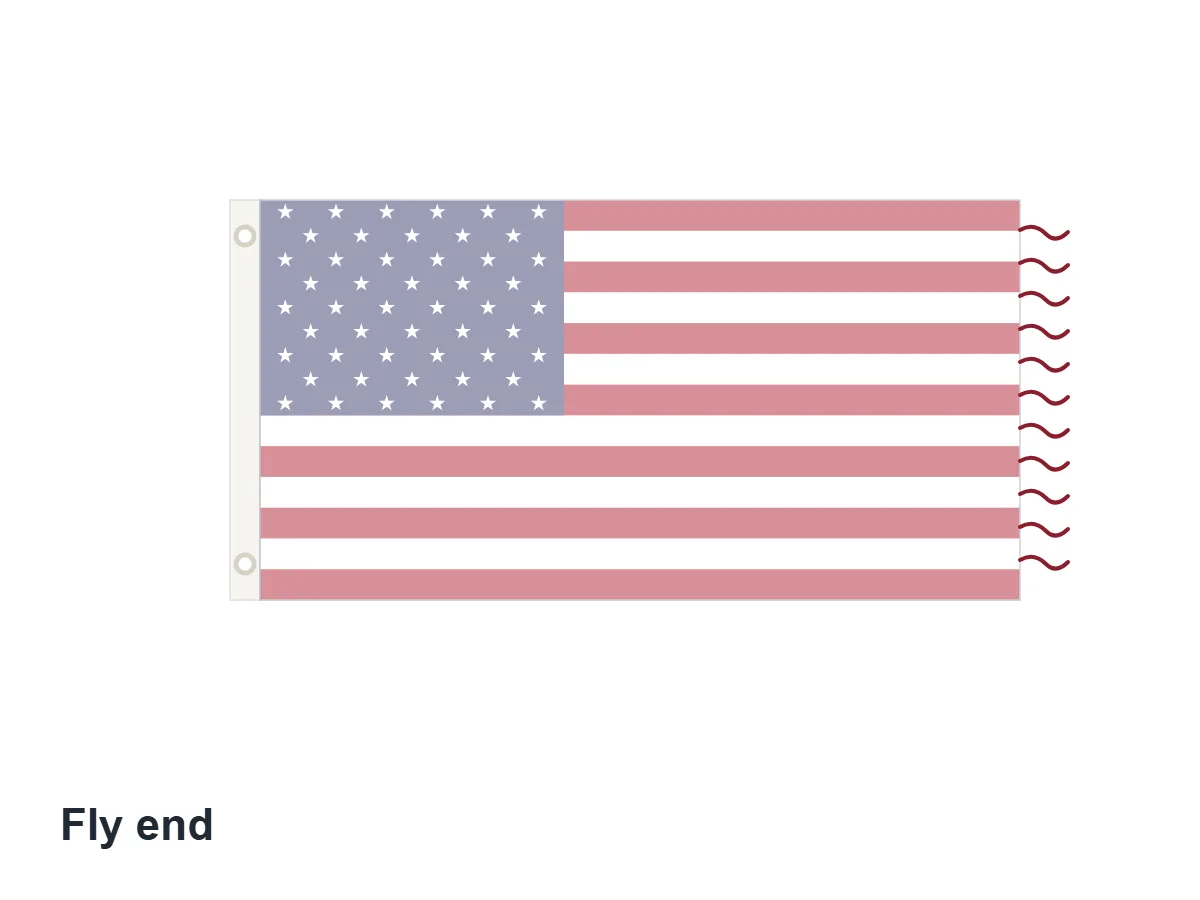
The outer edge opposite the hoist. Wear begins here and moves inward.
The face of the flag
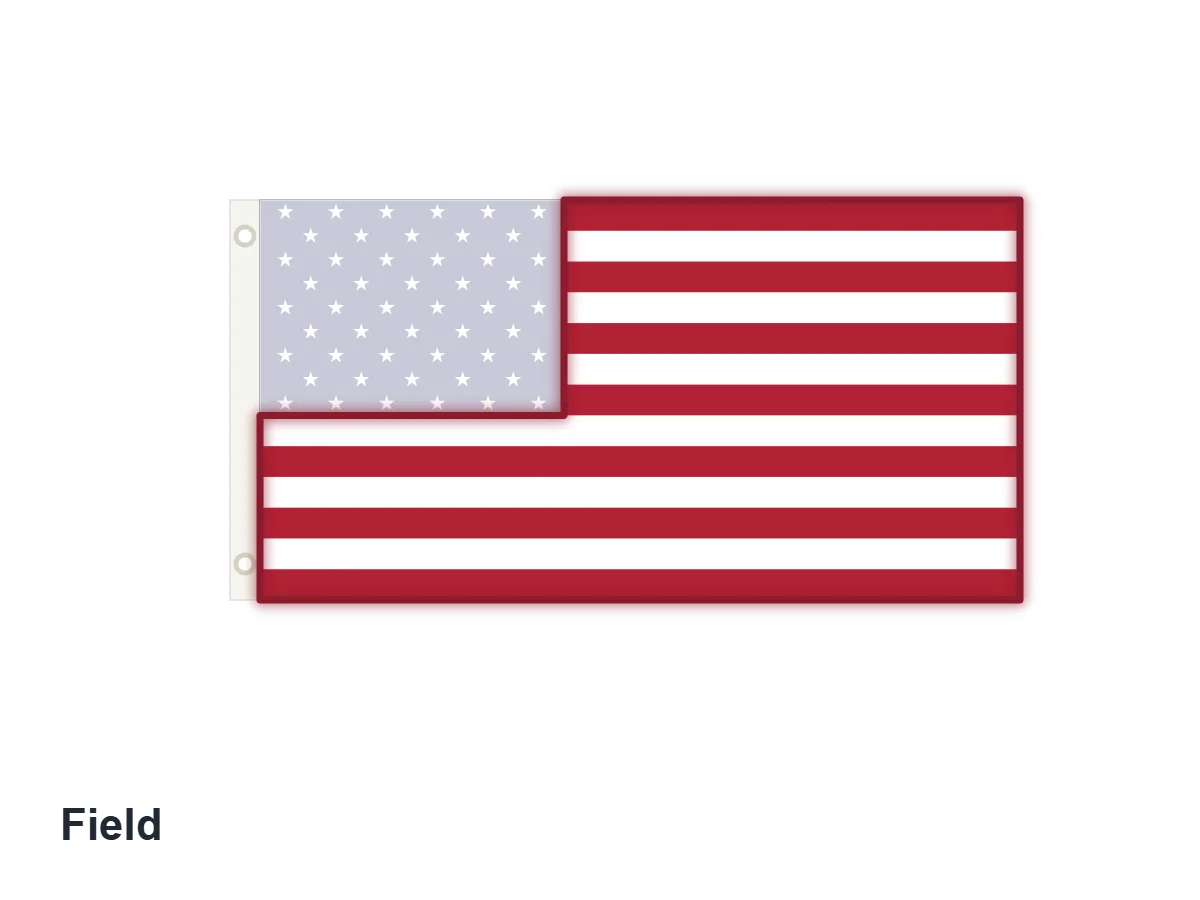
Field
The background area behind any device. On the US flag, the thirteen red and white stripes.
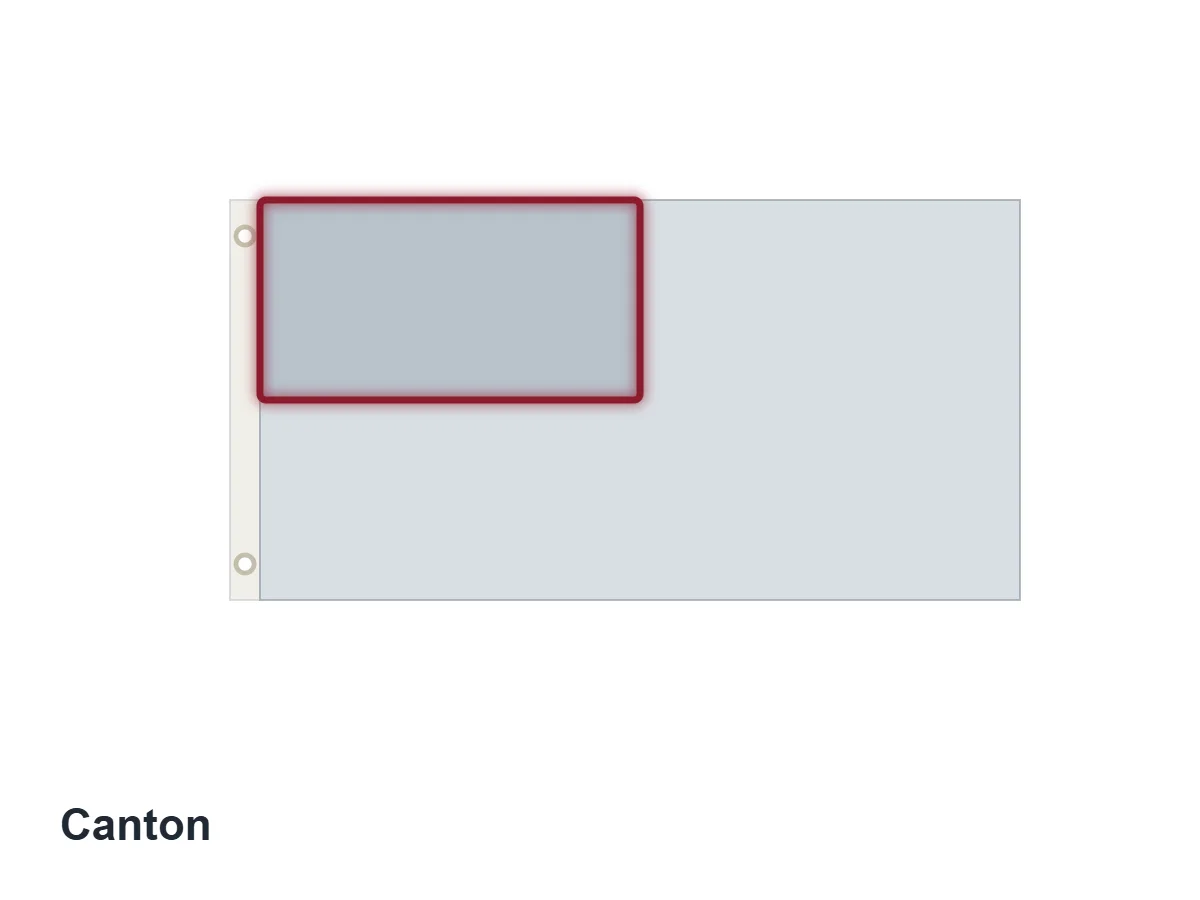
Canton
A rectangular section occupying a corner of a flag, almost always the upper corner nearest the hoist. A generic term; any flag can have one.
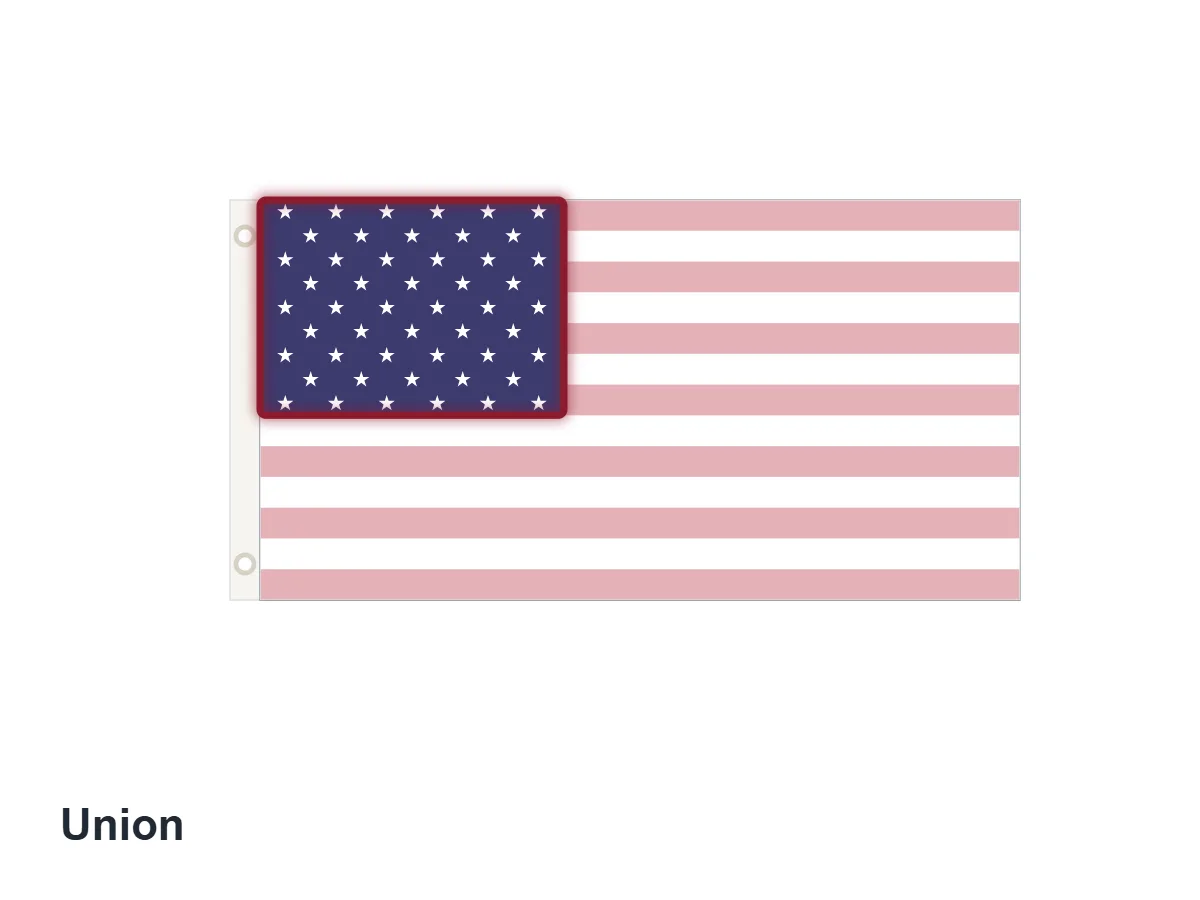
Union
The canton when it carries the emblem of a nation or state. On the US flag, the blue star field. This is the term used in 4 U.S.C. Chapter 1.
The hoist edge
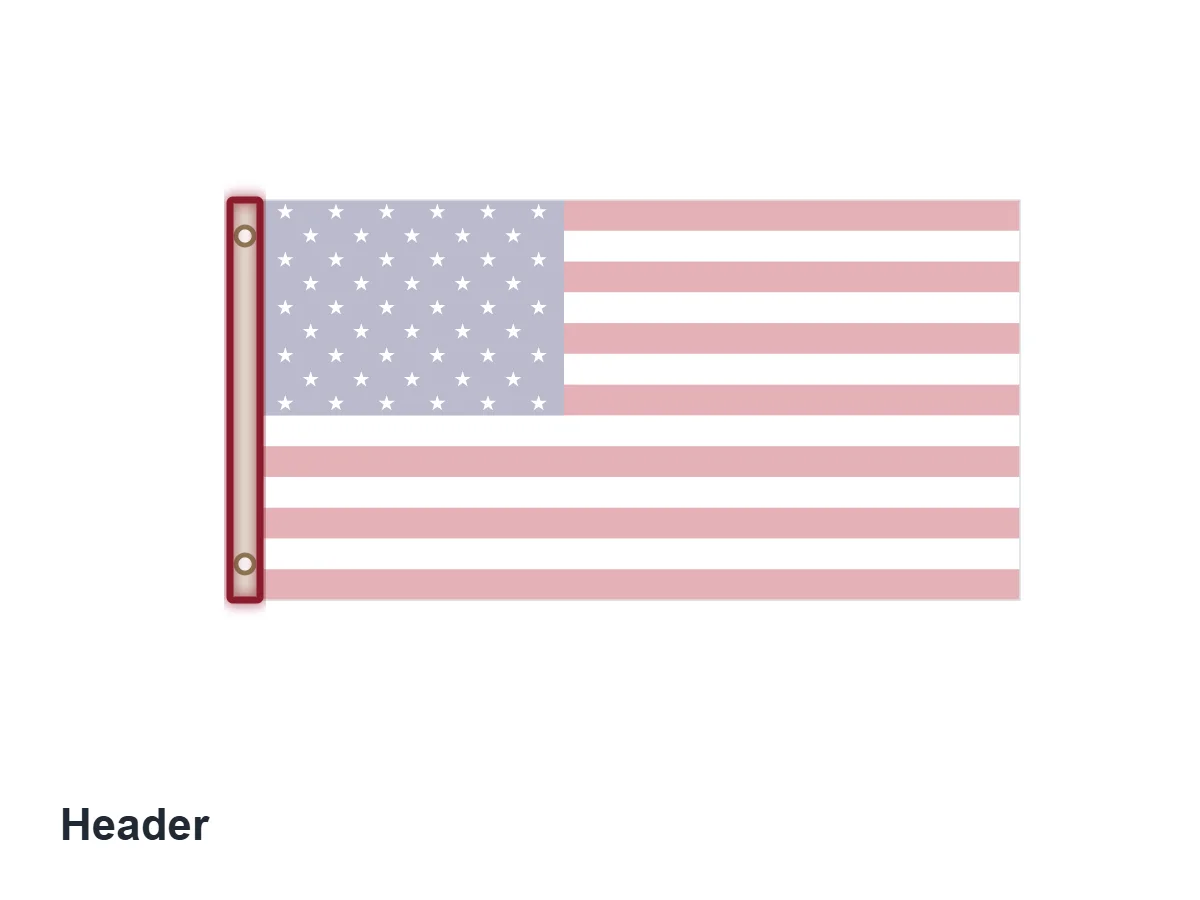
Header
The reinforced strip sewn along the hoist edge, in canvas or poly-cotton. It carries the load. Header width scales with flag size: typically 1-1/2″ up to 5′ x 9-1/2′, 2″ from 6′ x 10′ up, and doubled 3″ on the largest sizes.
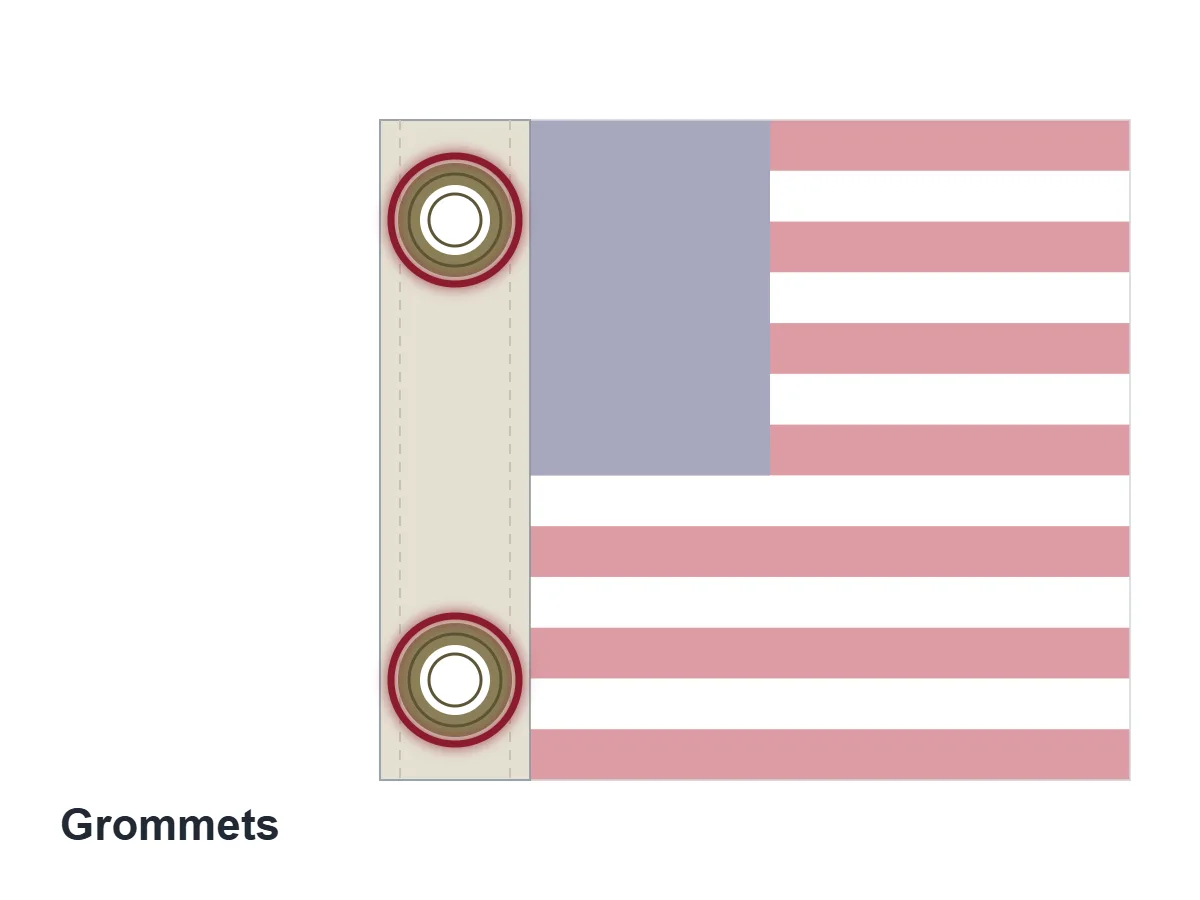
Grommets
Metal rings, usually brass, set into the header. Two on flags up to 6′ x 10′. Larger flags carry more, or switch to a roped heading.
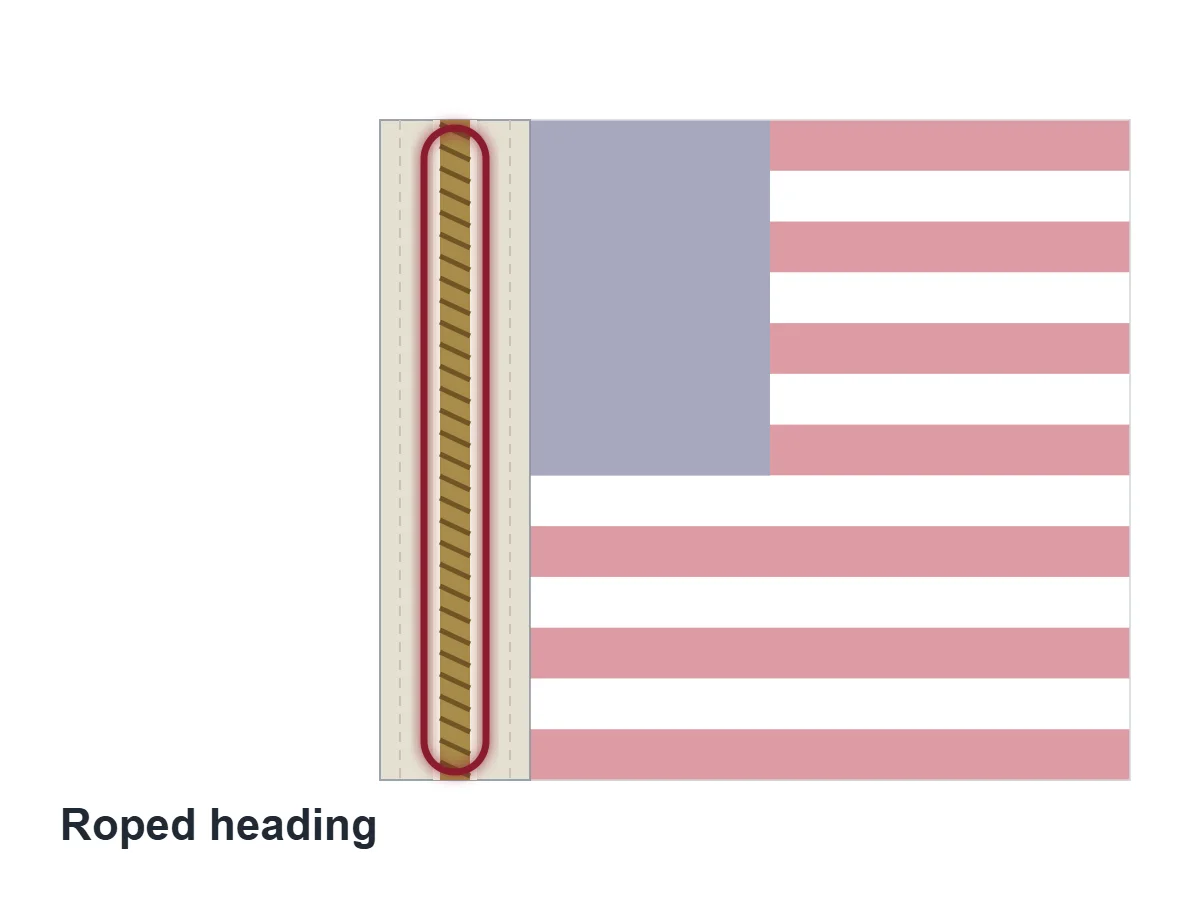
Roped heading
A rope sewn into the header in place of grommets. Standard above roughly 8′ x 12′. It distributes load along the full hoist edge rather than concentrating it at two rings.
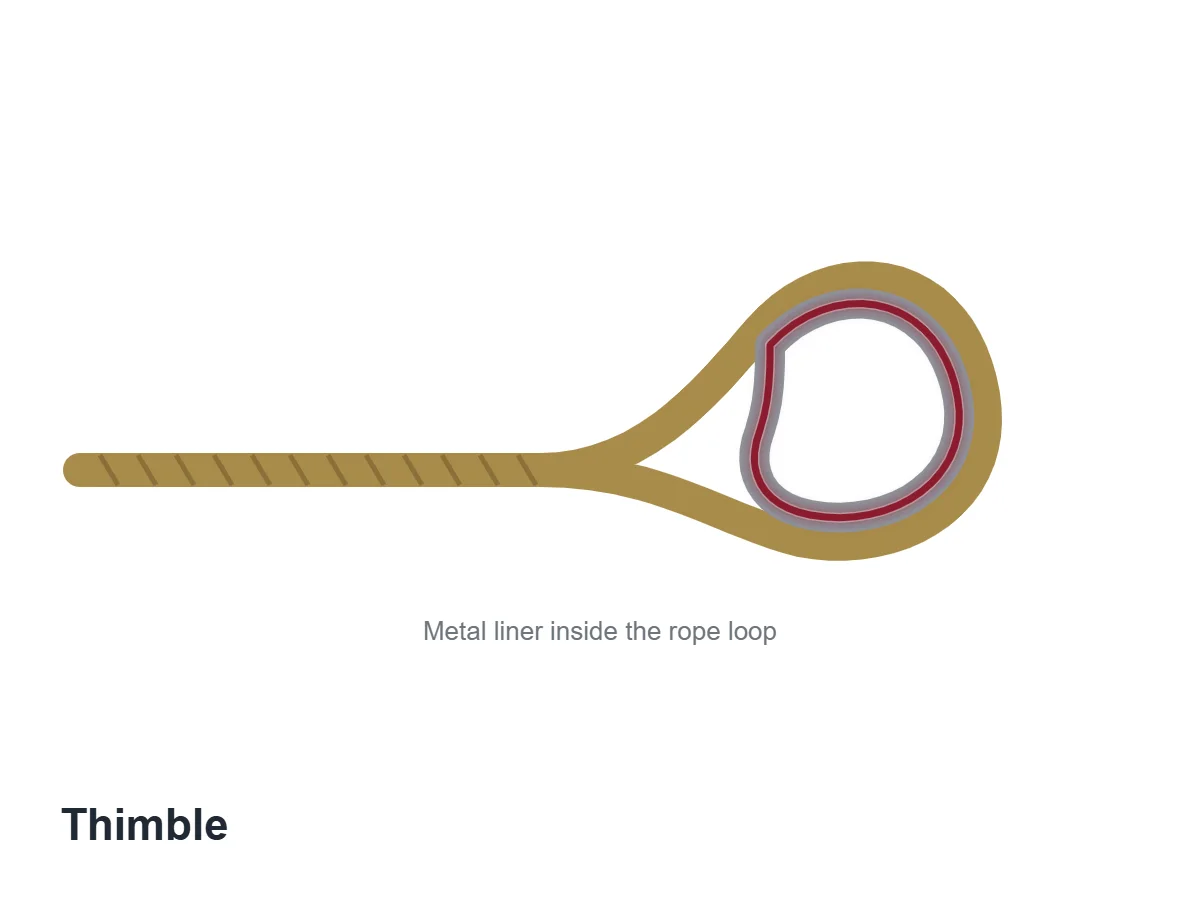
Thimble
A metal loop spliced into the top and bottom of a roped heading. Two per flag.
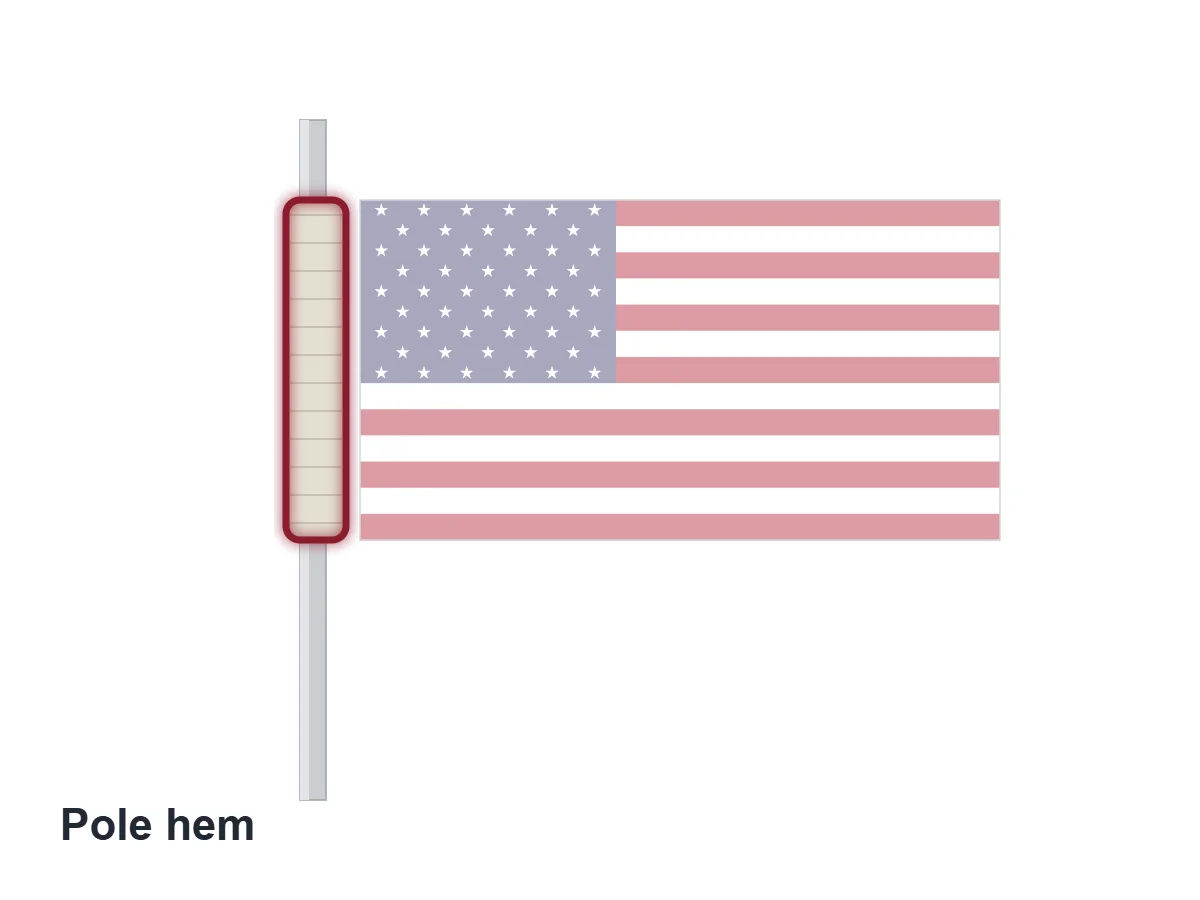
Pole hem
A fabric sleeve sewn along the hoist edge that slides onto a pole. The indoor, parade, and color guard attachment. Not interchangeable with header and grommets.
Reinforcement and trim
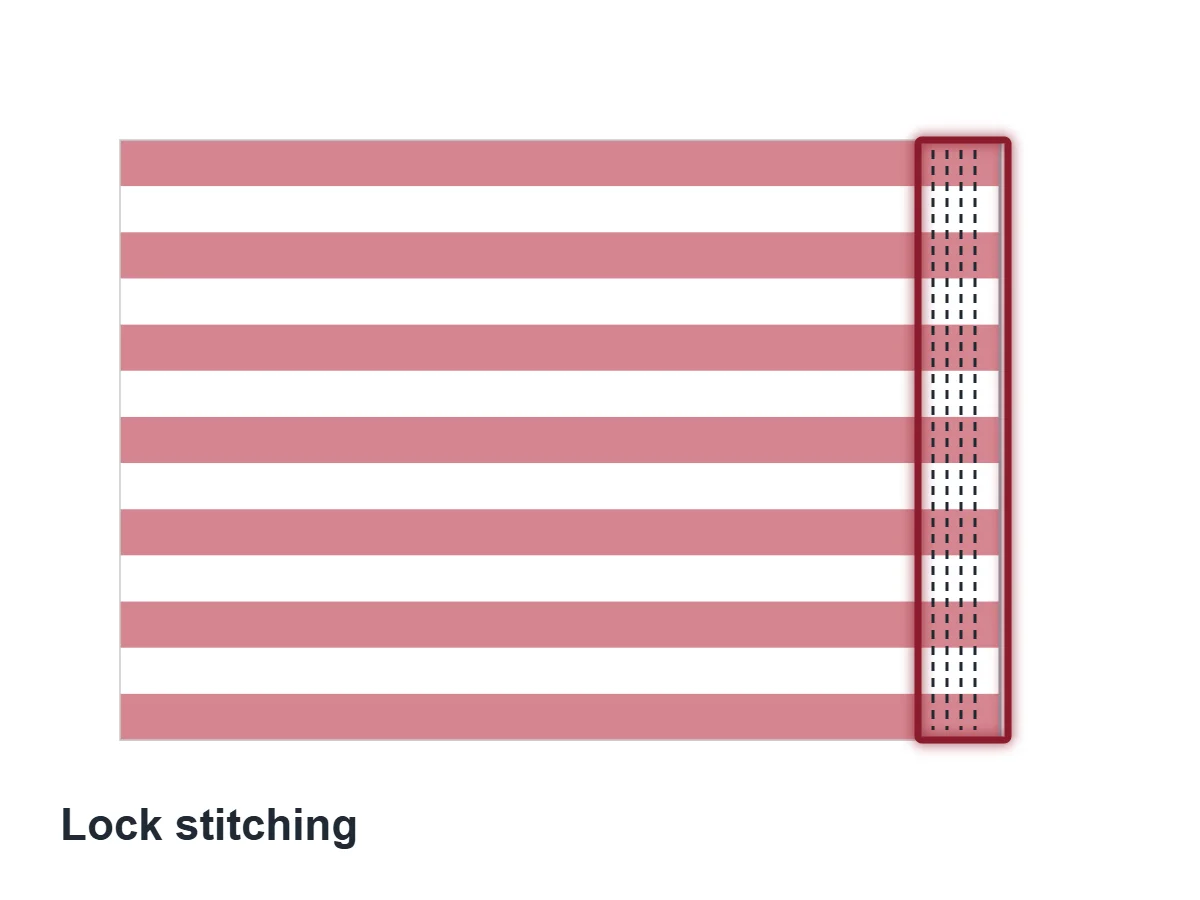
Lock stitching
Rows of tight stitching finishing the fly end. Row count scales with size: typically 4 rows up to 5′ x 9-1/2′, 6 rows from 6′ x 10′, and 8 rows on the largest flags.
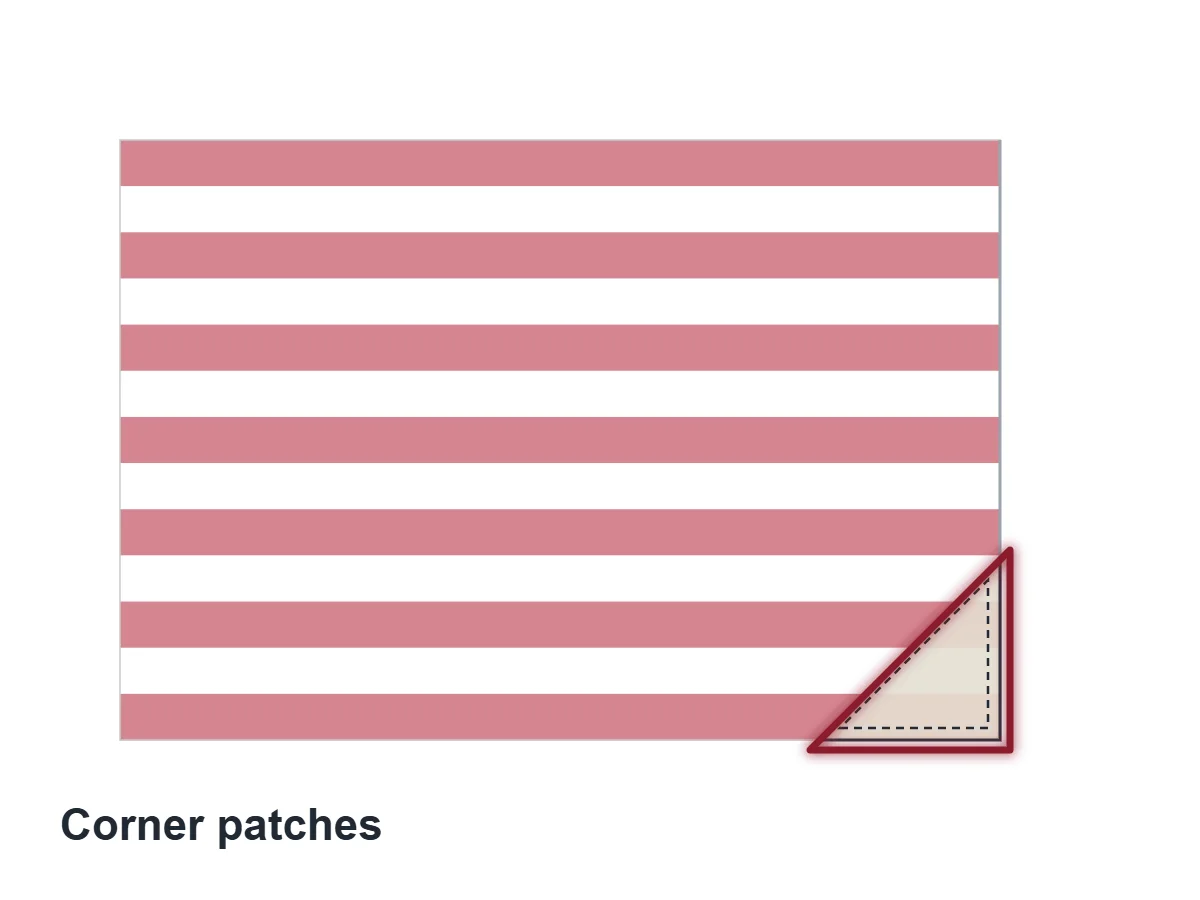
Corner patches
Additional fabric applied at the fly end corners. Standard from roughly 10′ x 15′ up.
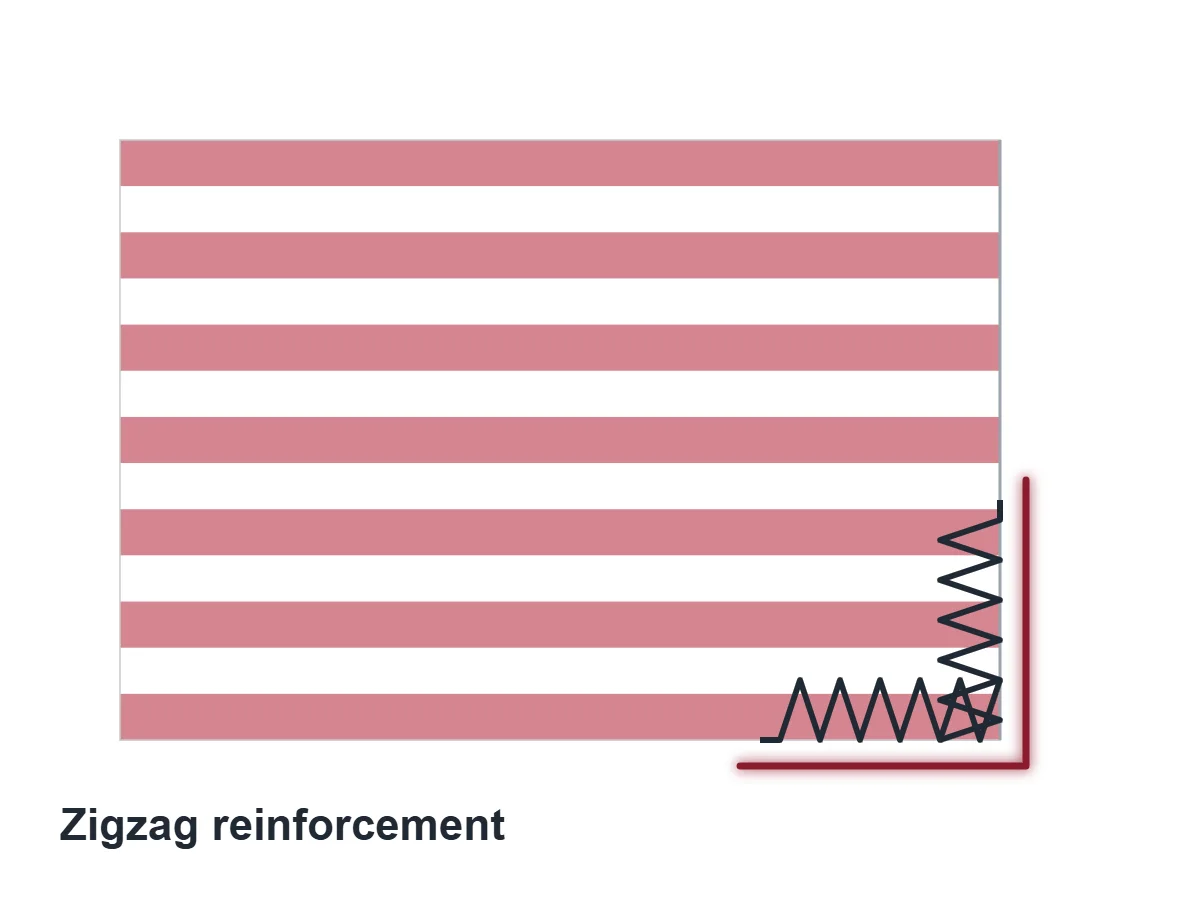
Zigzag reinforcement
Zigzag stitching applied at each fly end corner. Standard from roughly 8′ x 12′ up.
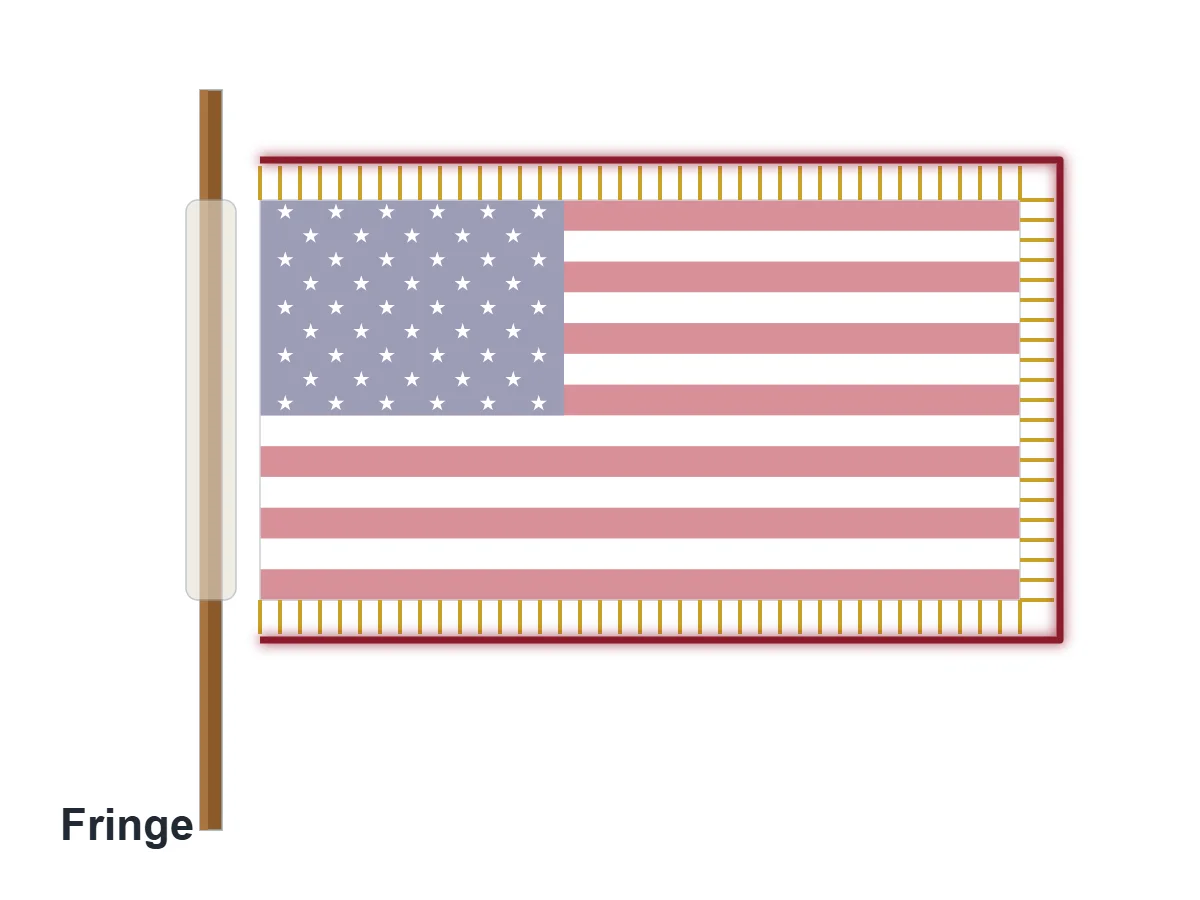
Fringe
Trim, usually gold or yellow rayon, applied to three edges of an indoor or ceremonial flag. It carries no legal or rank meaning and is not used outdoors.
Star construction: 3 methods
Stars are made three ways. The method sets the cost and how sharp the stars look at a distance.
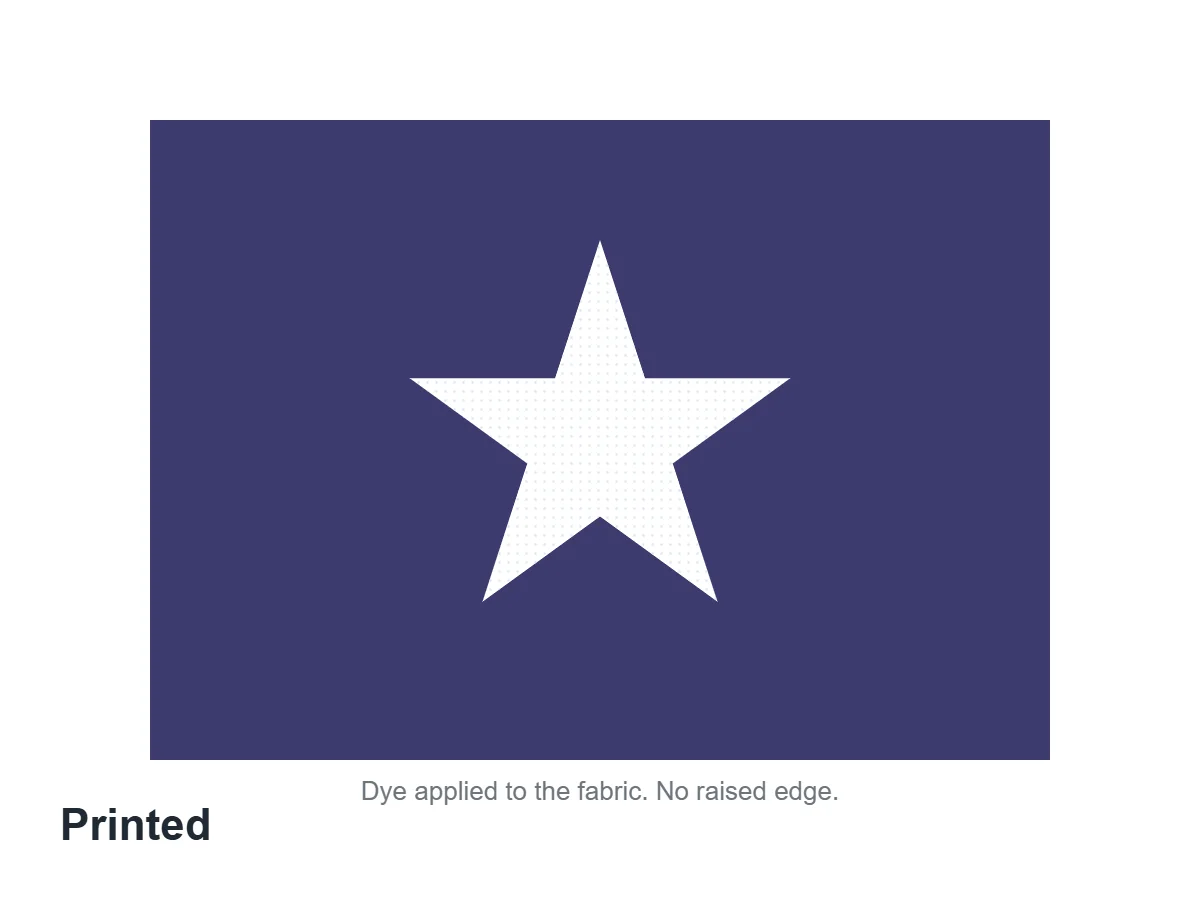
Printed
The design is applied to the fabric with dye. Used on smaller flags, specialty flags, and custom printed work.
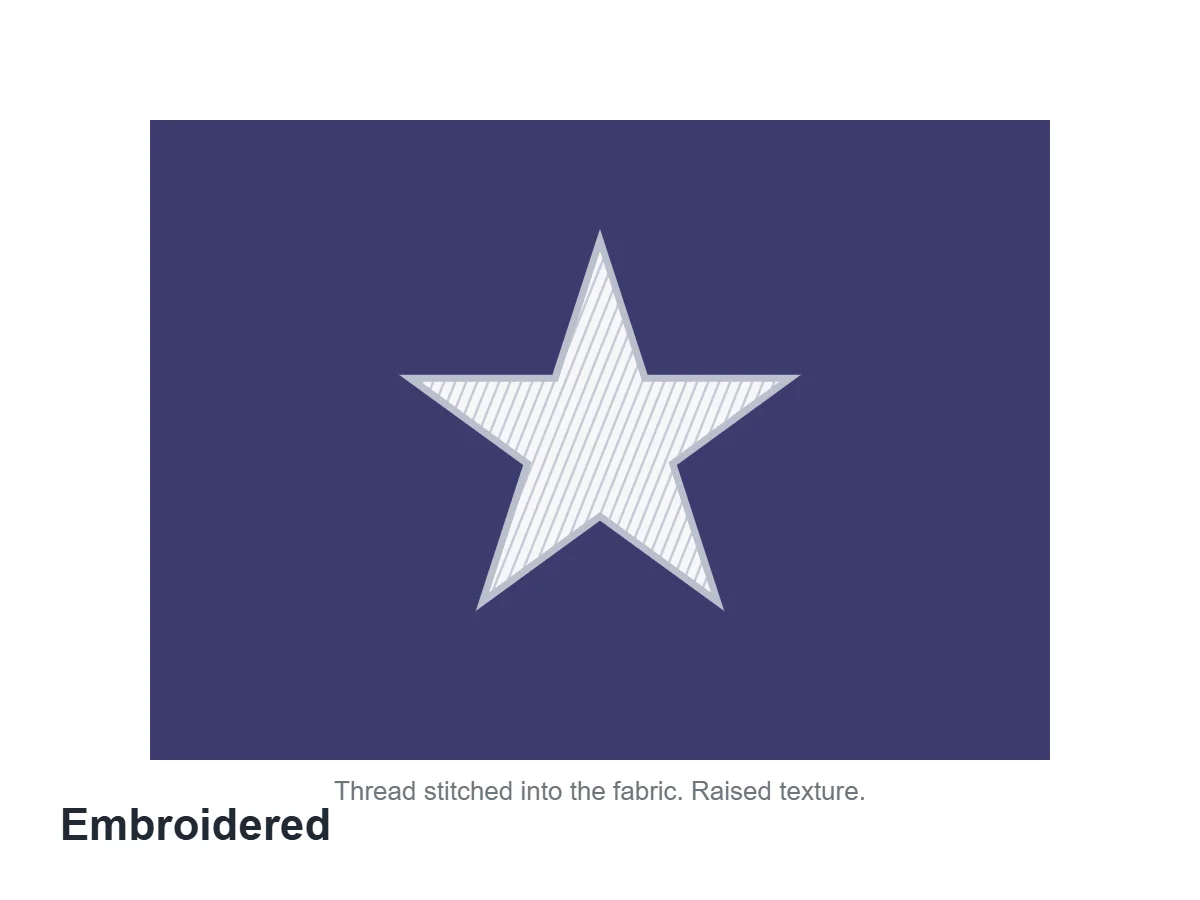
Embroidered
Stars are stitched in thread. Standard on sewn outdoor US flags from 3′ x 5′ through roughly 12′ x 18′.
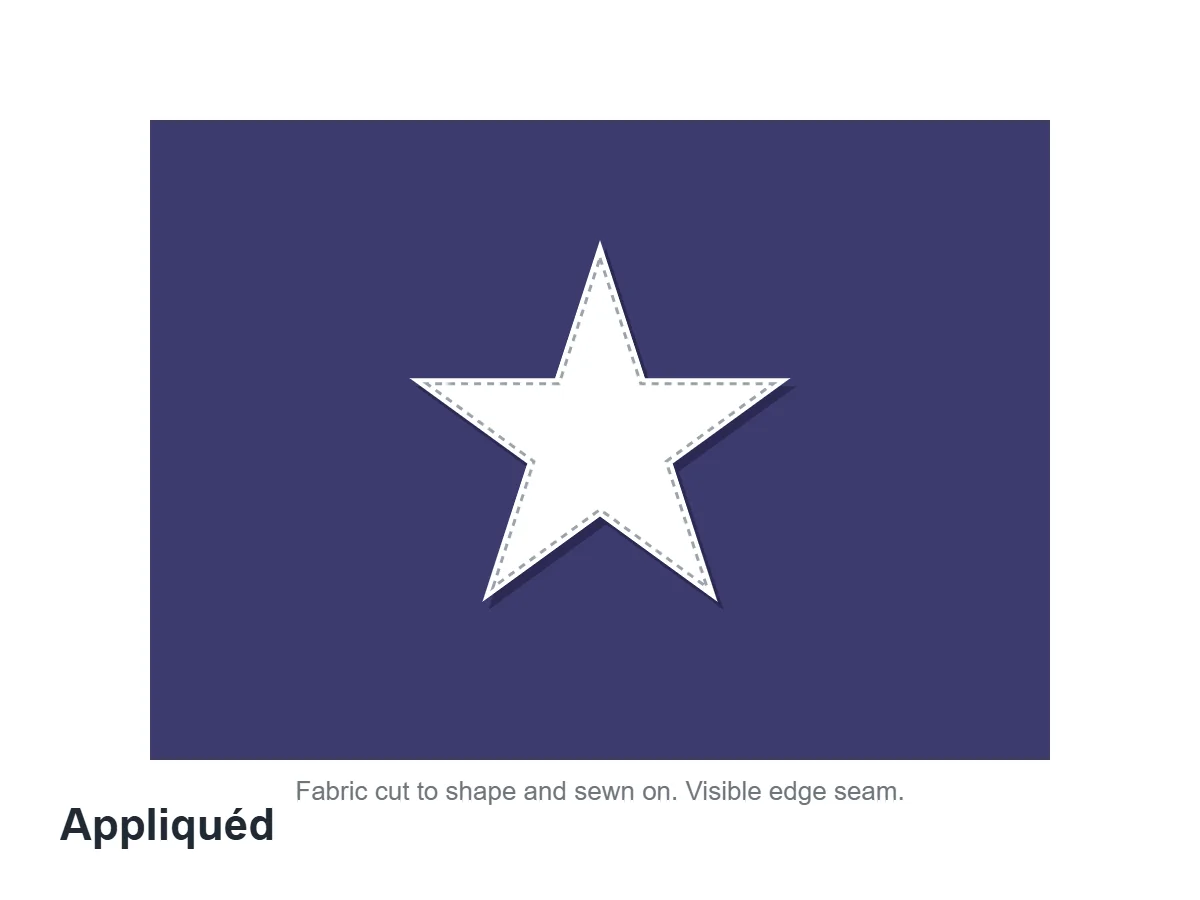
Appliquéd
Star-shaped fabric is cut and sewn onto the union. Standard from roughly 15′ x 25′ up, and used on most custom sewn flags.
The flagpole: 7 parts
The pole has its own vocabulary. These seven names come up on almost every hardware order.
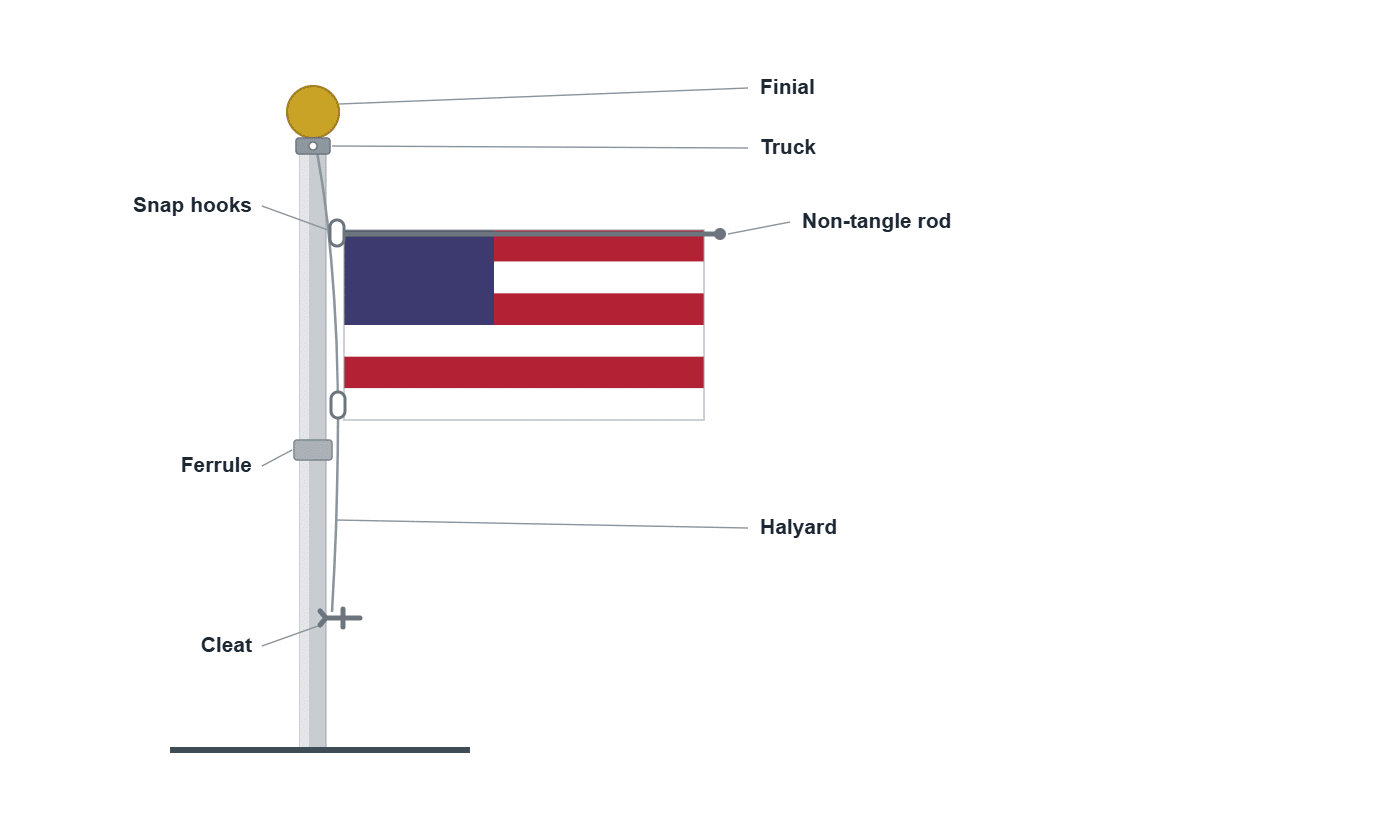
At the top
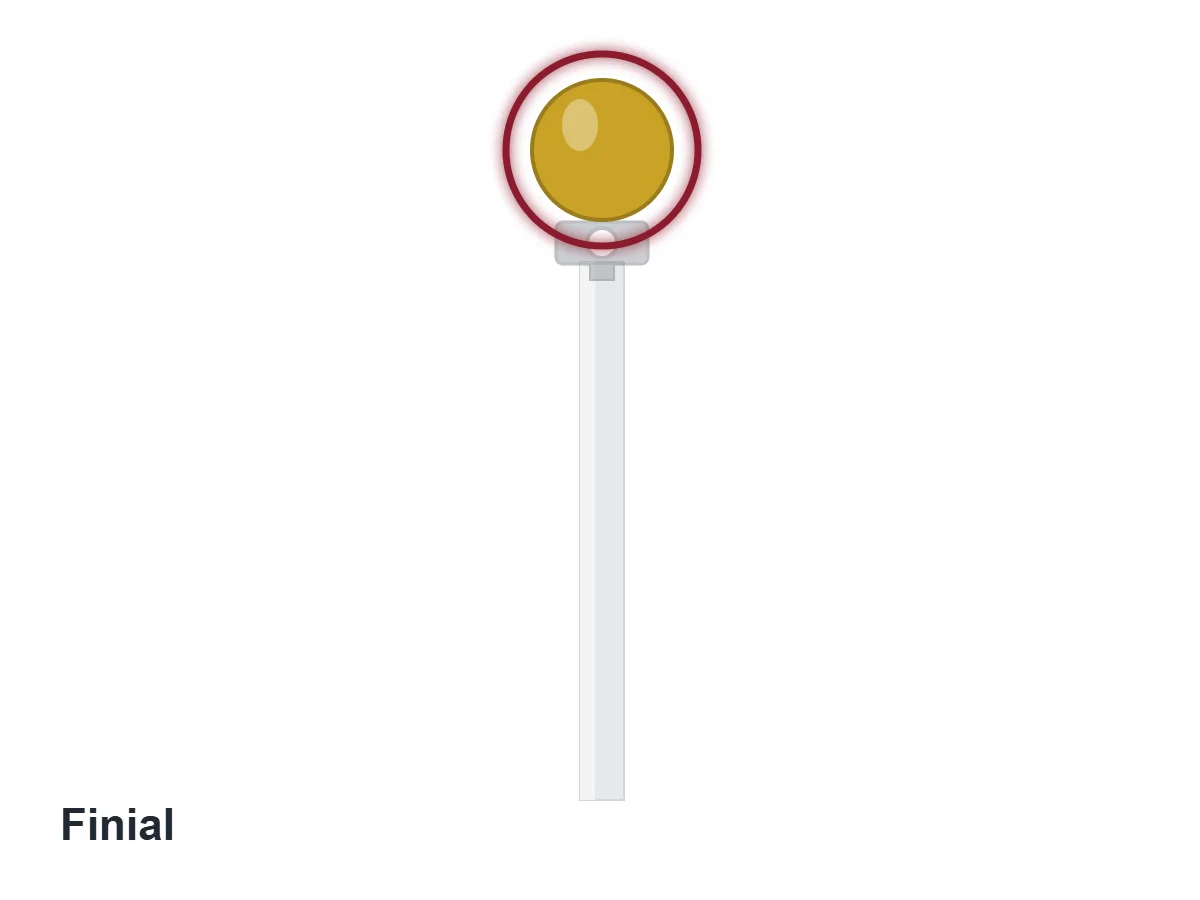
Finial
The ornament capping the pole. A gold ball outdoors. A spear or eagle on indoor and ceremonial poles.
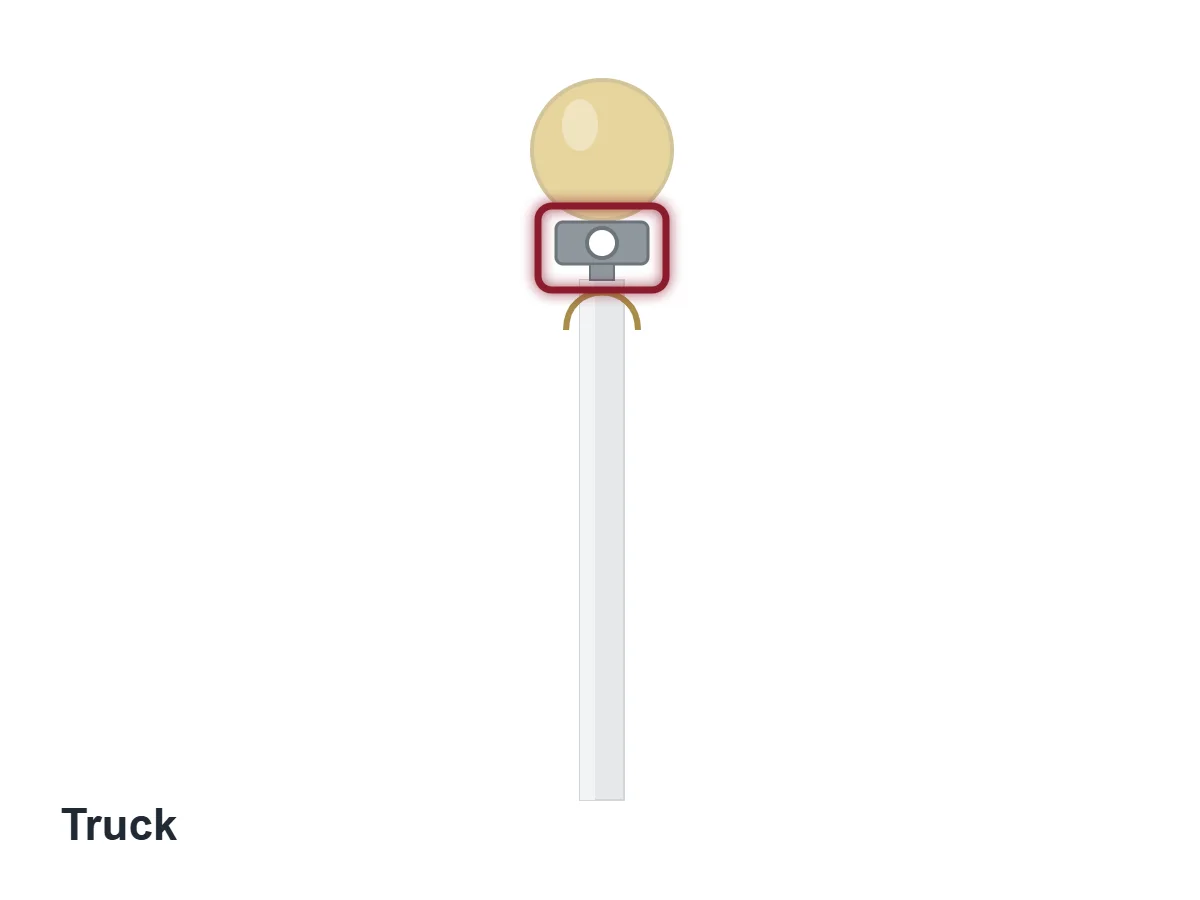
Truck
The assembly at the very top of the pole housing the pulley the halyard runs over.
Along the pole
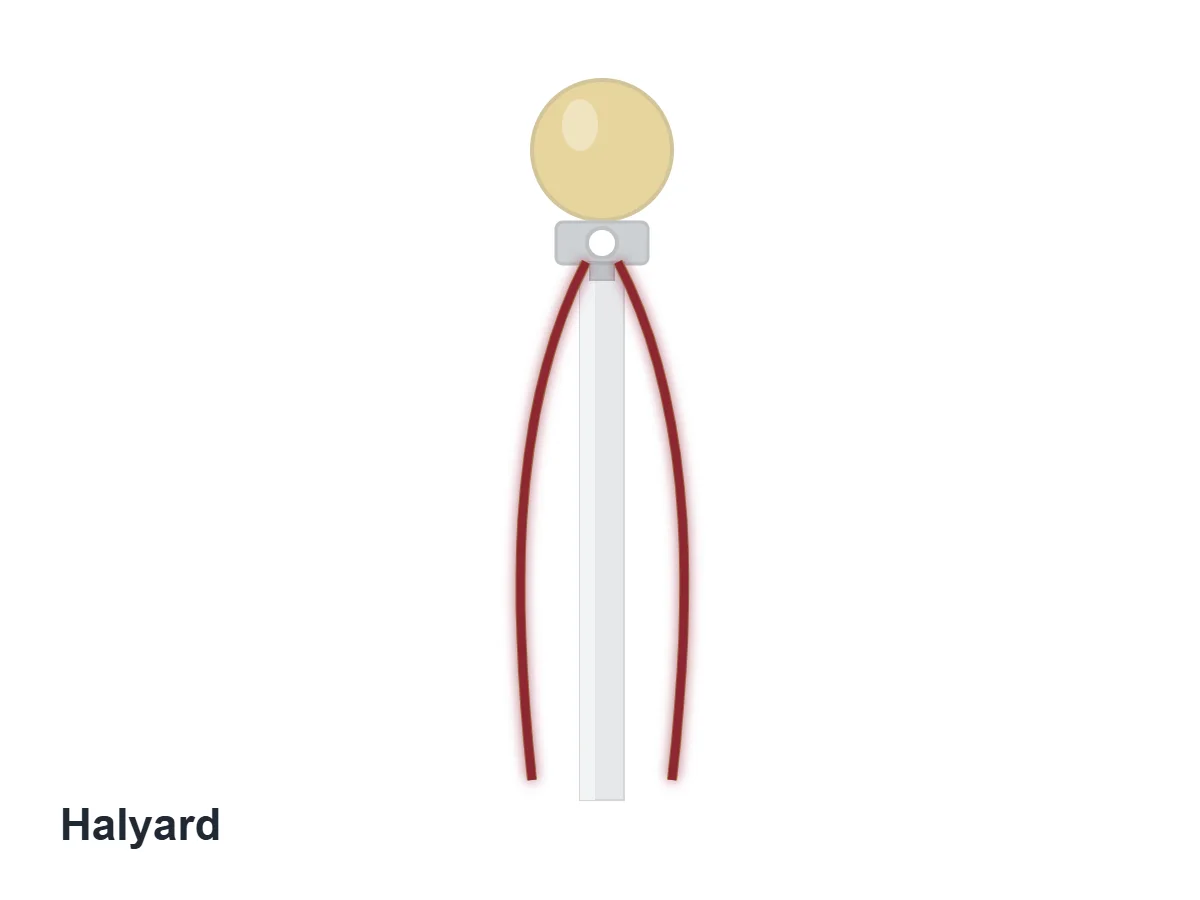
Halyard
The rope that raises and lowers the flag.
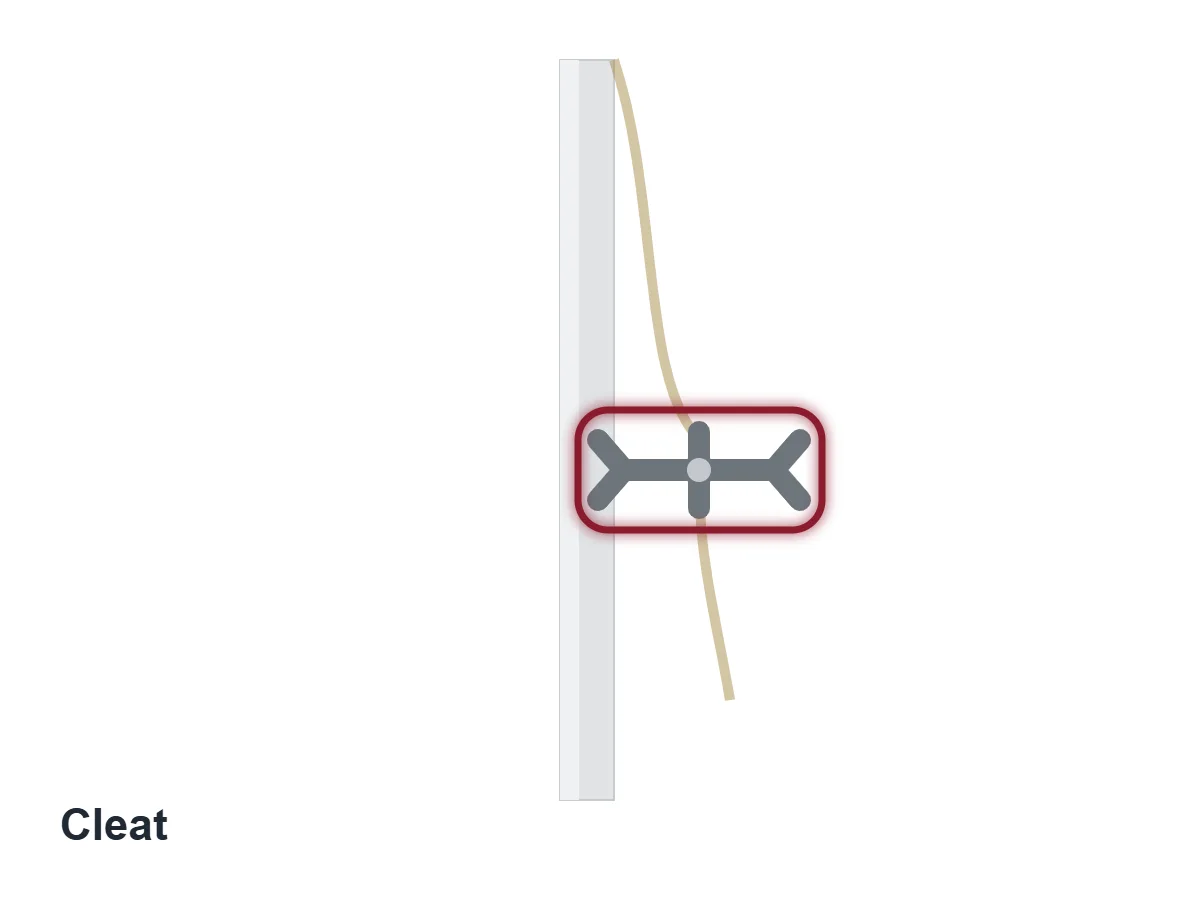
Cleat
The fitting on the pole where the halyard ties off.
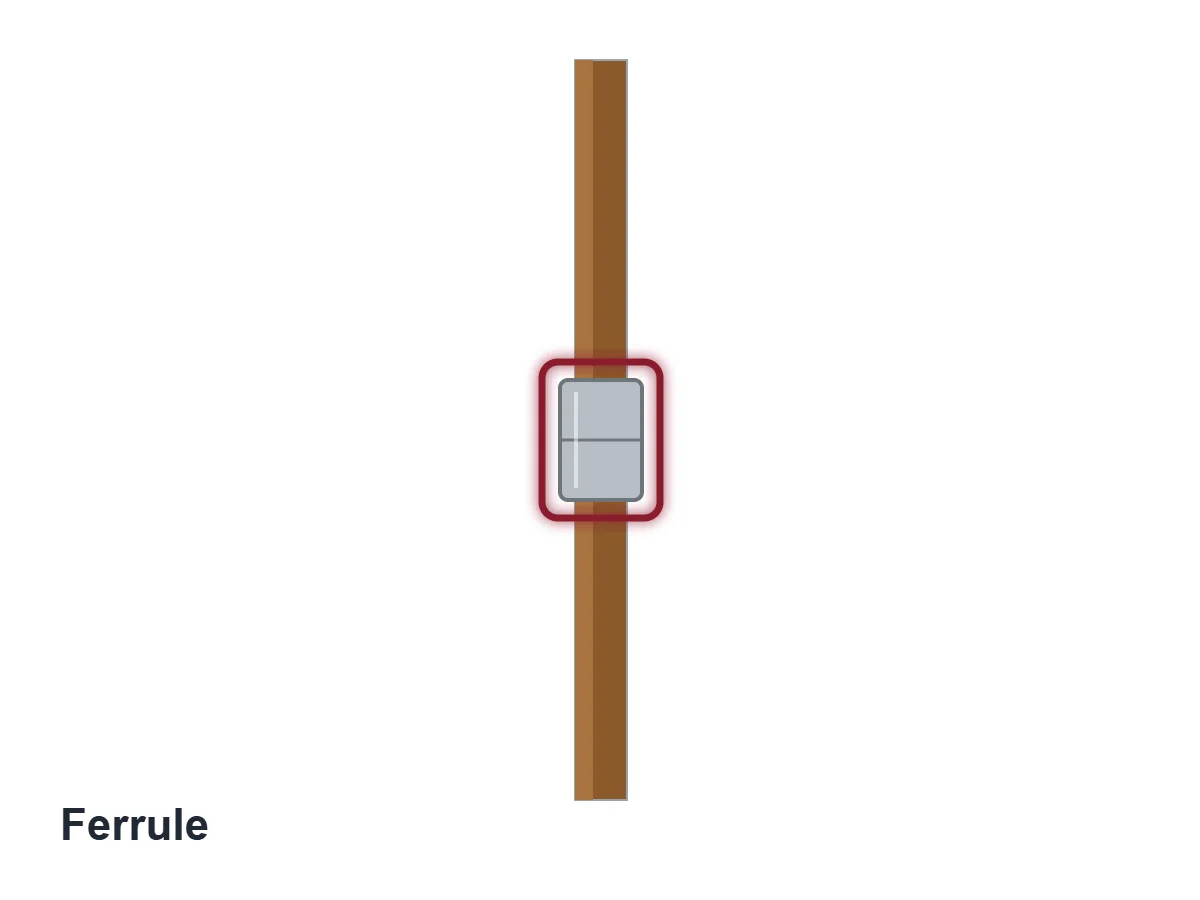
Ferrule
The sleeve joining two sections of an indoor or parade pole.
Where the flag attaches
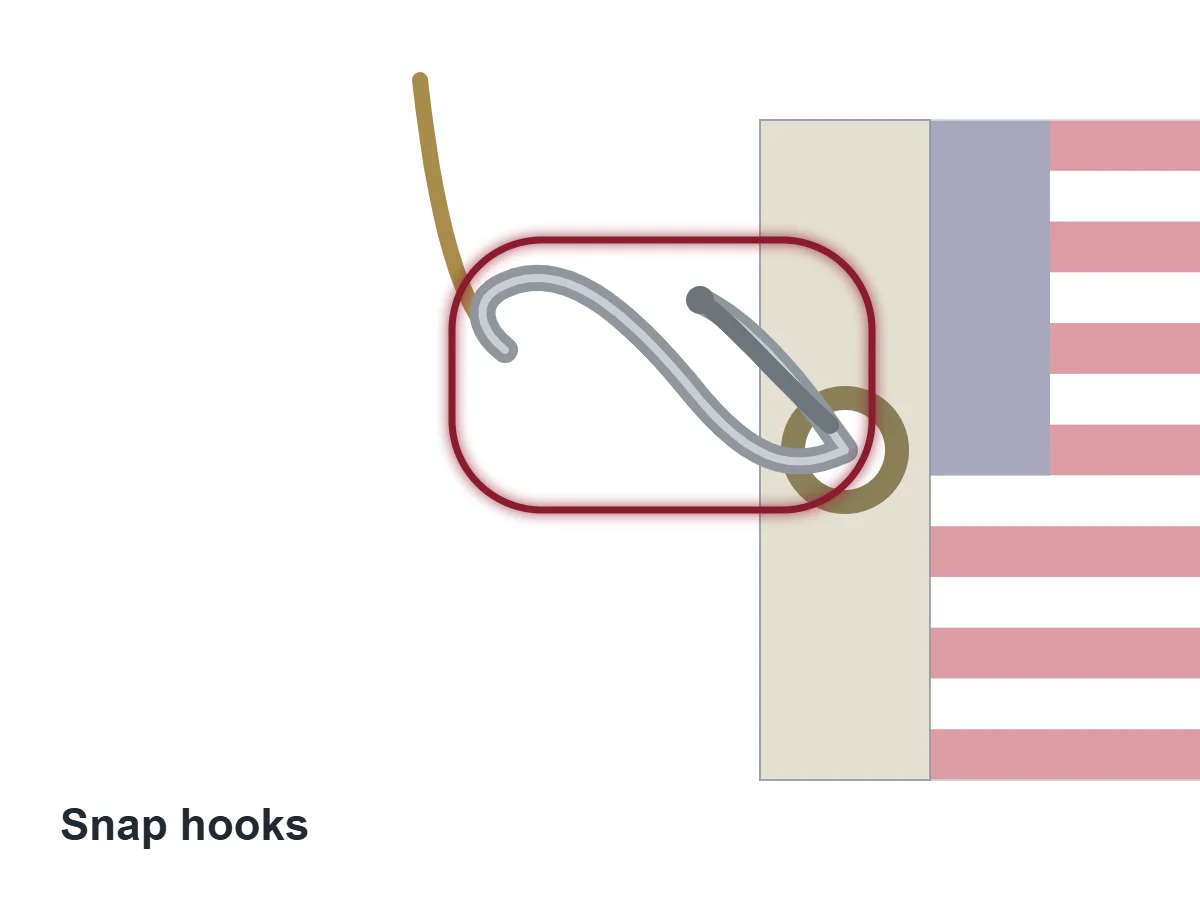
Snap hooks
Clips joining the halyard to the grommets. Vinyl-coated or covered hooks reduce wear on the header.
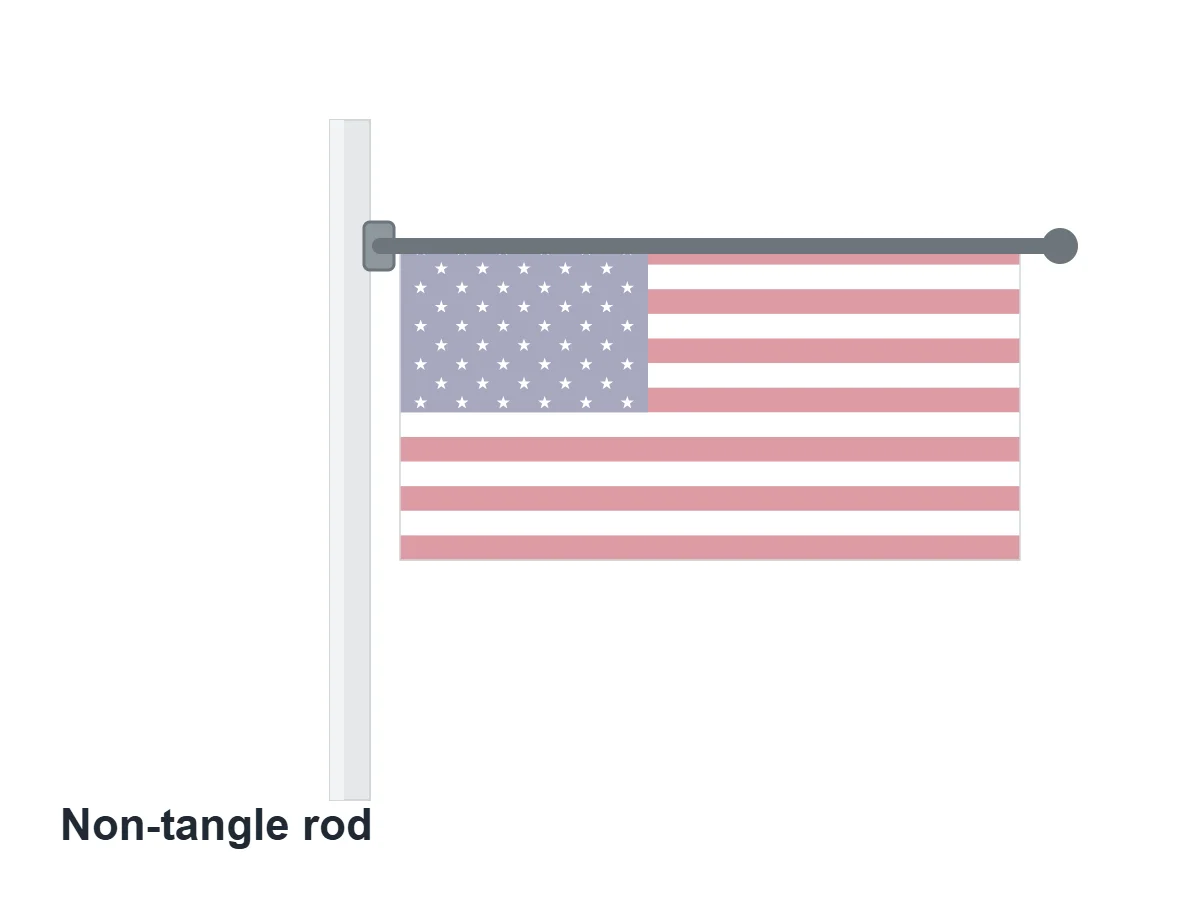
Non-tangle rod
An arm holding the flag out from the pole so it cannot wrap around itself.
All 25 parts of a flag at a glance
Every term on this page in one table, with the group it belongs to and a one-line definition.
| Term | Group | Definition |
|---|---|---|
| Hoist |
Flag | The edge nearest the pole. Also the vertical dimension. |
| Fly |
Flag | The edge farthest from the pole. Also the horizontal dimension. |
| Fly end |
Flag | The outer edge opposite the hoist. Where wear begins. |
| Field |
Flag | The background. On the US flag, the thirteen stripes. |
| Canton |
Flag | A rectangular section in a corner, usually upper hoist. |
| Union |
Flag | The canton when it carries the national or state emblem. |
| Header |
Flag | Reinforced canvas or poly-cotton strip along the hoist edge. |
| Grommets |
Flag | Metal rings, usually brass, set into the header. |
| Roped heading |
Flag | Rope sewn into the header in place of grommets. |
| Thimble |
Flag | Metal loop spliced into each end of a roped heading. |
| Pole hem |
Flag | Fabric sleeve along the hoist edge that slides onto a pole. |
| Lock stitching |
Flag | Rows of tight stitching finishing the fly end. |
| Corner patches |
Flag | Added fabric at the fly end corners. |
| Zigzag reinforcement |
Flag | Zigzag stitching at the fly end corners. |
| Fringe |
Flag | Trim, usually gold rayon, on three edges of an indoor flag. |
| Printed |
Stars | Design applied to the fabric with dye. |
| Embroidered |
Stars | Stars stitched in thread. |
| Appliquéd |
Stars | Star-shaped fabric cut and sewn onto the union. |
| Finial |
Pole | The ornament capping the pole. Usually a ball. |
| Truck |
Pole | The assembly at the pole top housing the pulley. |
| Halyard |
Pole | The rope that raises and lowers the flag. |
| Cleat |
Pole | The fitting where the halyard ties off. |
| Ferrule |
Pole | Sleeve joining two sections of an indoor or parade pole. |
| Snap hooks |
Pole | Clips joining the halyard to the grommets. |
| Non-tangle rod |
Pole | Arm holding the flag out so it cannot wrap the pole. |
Common questions about the parts of a flag
Related reading
Once you know the parts of a flag by name, these cover what to buy and how to keep it flying:
- Nylon, polyester, or cotton: how to pick a flag material
- US flag etiquette: what the Flag Code actually says
- Repair it or retire it: how to tell when a flag is done
- How long a flag lasts, and how to make it last longer
- Choose the right size flag for your flagpole
Browse US flags, hardware and accessories, or flag repair services. Questions on a specification, contact us.


