On this page
Tuesday, October 27, 2026, is Navy Day. Fly the United States flag at full staff, sunrise to sunset.
Navy Day is the oddest entry in the US Flag Code. The federal government stopped observing it in 1949, but the law still lists it.
How to Fly the Flag on Navy Day
The United States flag flies at full staff, sunrise to sunset. If it is lit, it can fly around the clock under 4 U.S.C. §6(a).
There is no half-staff, no noon change, and no required ceremony. Navy Day sits in the 4 U.S.C. §6(d) list with Independence Day and Thanksgiving, and that list asks one thing: put the US flag up.

A Navy flag is optional. If you fly one, it goes below the US flag on the same halyard. On a separate pole, it goes to the US flag’s own left, which is the viewer’s right.
October 27th Is Not the Navy’s Birthday
The two dates get mixed up constantly.
The Navy’s birthday is October 13. On that day in 1775, the Continental Congress authorized the first vessels.
Navy Day is October 27, Theodore Roosevelt’s birthday. Roosevelt served as Assistant Secretary of the Navy and pushed for a larger fleet as president. The Navy League of the United States created Navy Day in his honor in 1922.
One date marks the Navy’s founding. The other honors its loudest advocate. If you write for a Navy audience, get this one right.
Gone Since 1949, Still in the Flag Code
Navy Day was observed from 1922 to 1949.
In 1949 the new Department of Defense merged the Army, Navy, and Air Force days into one Armed Forces Day, held the third Saturday in May. That ended Navy Day as an official observance.
The Flag Code never caught up. Navy Day is still listed in 4 U.S.C. §6(d), between Columbus Day and Veterans Day. Armed Forces Day is in the same list, so the day and its replacement sit four entries apart.
The lesson for anyone keeping a flag schedule: the Flag Code is not a live calendar. Congress adds to it far more often than it trims it. Treat the statute as your minimum, and check the current presidential proclamations for what is happening this year. They are published in the Federal Register and on whitehouse.gov.
The Navy Flag Is Not the Ensign
A Navy ship does not fly the Navy flag. It flies the United States flag as its ensign.

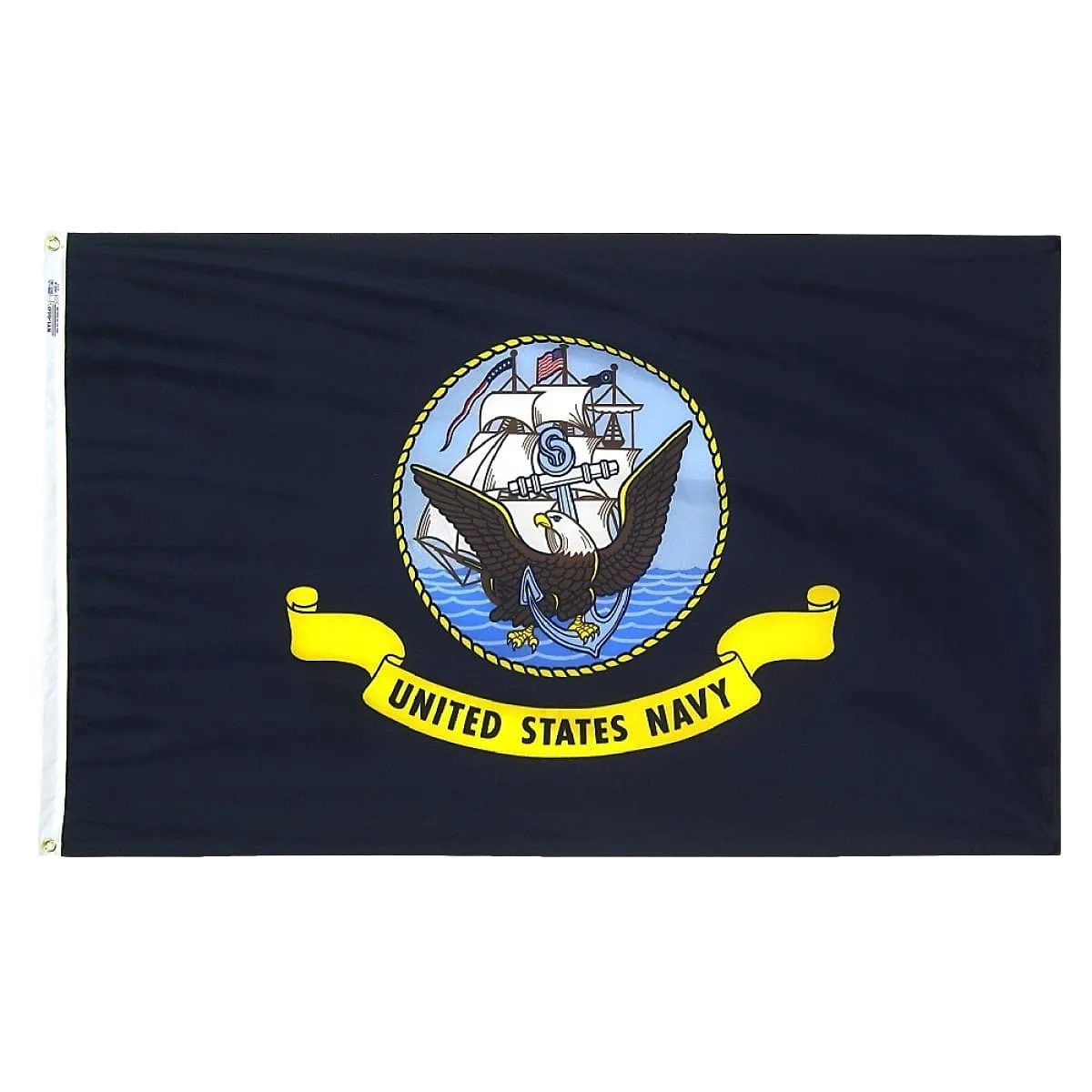
The blue Navy flag, with the Department of the Navy seal above a yellow UNITED STATES NAVY scroll, is a service flag for parades, ceremonies, and offices ashore. President Eisenhower created it with Executive Order 10812 on April 24, 1959, and set its size: 4 FT 4 IN by 5 FT 6 IN, dark blue, with a 2 1/2 IN yellow fringe.

Those are the dimensions of an indoor flag on a staff. If someone asks for a Navy flag for a ceremony, they want the blue service flag. If they ask what flies on a ship, the answer is the US flag.
Where the Navy Flag Goes in a Lineup
Service flags go in this order: Army, Marine Corps, Navy, Air Force, Space Force, and Coast Guard.
The order does not follow founding dates. The Navy is older. The Continental Congress authorized its first ships on October 13, 1775, almost a month before it created the Marines on November 10, 1775.
The Marine Corps has ranked ahead of the Navy since 1921. At the time, the Navy dated its founding to the 1790s, so it was treated as the younger service. The Navy adopted October 13, 1775, as its birthday in 1972, but the order of precedence never changed.
The Coast Guard is the exception. In peacetime it goes last. In wartime, when it operates as part of the Navy, it moves up to follow the Navy and precede the Air Force.
The US flag leads them all. Under 4 U.S.C. §7(c), no flag goes above it or to its right on American soil. That means the US flag’s own right, which is the viewer’s left. No other flag should stand to the viewer’s left of the US flag at the same height.
For state, city, and organizational flags, see our guide to the flag order of precedence.
Navy Day Checklist

- US flag at full staff, sunrise to sunset. Light it if it stays up overnight.
- US flag first. A Navy flag goes below it on the same halyard. On separate poles, it goes to the US flag’s own left, which is the viewer’s right.
- Check the fly end. Late October wind finds weak stitching, and the fly end fails first.
- Get the date right. October 13 is the Navy’s birthday. October 27 is Navy Day.
Common questions
Related reading
Sources
- 4 U.S.C. §6, Time and occasions for display · uscode.house.gov
- 4 U.S.C. §7, Position and manner of display · uscode.house.gov
- Executive Order 10812, Establishing a Flag for the United States Navy (Apr 24, 1959) · presidency.ucsb.edu
- Navy Day · National Naval Aviation Museum · history.navy.mil
- Who Has Precedence: Navy or Marines? · military.com
- Flag Precedence: Why the Marine Corps Is Senior to the Navy · dla.mil
Where to Buy

- All sizes and finishes: US Flags
- Pole hem, fringe, and grommet styles: Navy Flags


