Product Description
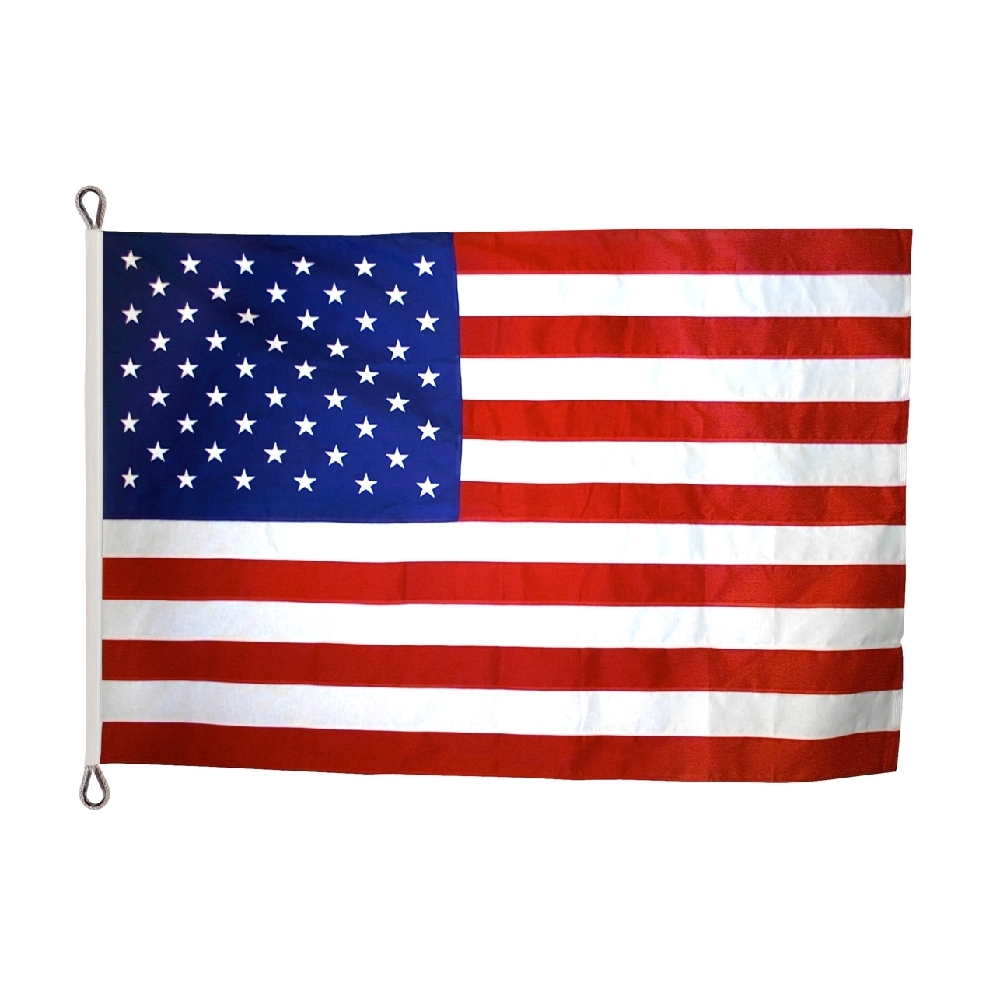
This large nylon American flag is built for tall poles that need a flag that flies in ordinary wind. The UV-resistant 200 denier nylon is light enough to lift on a calm day, which matters on a 40 FT or 60 FT pole where a heavy flag would hang most of the week. The stars are densely embroidered in vivid white thread and the stripes are sewn.
The heading is white poly/cotton duck with a braided nylon rope through it and two galvanized chrome steel thimbles for the halyard snaps. Ten sizes run from 8 FT x 12 FT to 50 FT x 80 FT, and every flag is made in the USA. For steady high wind, see the polyester version instead.
Large Nylon American Flag Features
- UV-resistant 200 denier nylon – fully dyed and treated so the reds stay red and the blue field stays deep through a season outdoors.
- Embroidered stars, sewn stripes – 50 densely embroidered vivid white stars and 13 sewn stripes give the flag a dimensional, finished look.
- Roped heading with thimbles – a braided nylon rope runs through the poly/cotton duck heading and ends in two galvanized chrome steel thimbles.
- Flies in light wind – nylon is the lightest flag fabric we make, so a big flag still shows the design when polyester would hang.
- Ten sizes – from 8 FT x 12 FT for a 40 FT pole to 50 FT x 80 FT for a landmark installation.
- Made in the USA – sewn here, as an American flag should be.
Historical Background
The Continental Congress adopted the Stars and Stripes on June 14, 1777, with 13 stripes for the original colonies and 13 stars for a new constellation. As states joined the Union the star count grew, and the 50-star pattern in use today was set on July 4, 1960 after Hawaii became a state. The rules for displaying the flag, including half-staff and nighttime display, are set out in the United States Flag Code.
Nylon became the standard outdoor flag fabric in the second half of the twentieth century because it holds dye well, sheds water, and weighs far less than cotton. On a tall pole that weight matters: a nylon flag moves in a breeze that leaves a polyester flag limp, which is why most institutional poles fly nylon except in the windiest locations.
Symbolism at a Glance
- Thirteen stripes: the original colonies that declared independence.
- Fifty stars: the states of the Union, one star for each.
- Red: hardiness and valor.
- White: purity and innocence.
- Blue: vigilance, perseverance, and justice.