
On this page
Wednesday, November 11, 2026, is Veterans Day. The Veterans Day flag rule is simple: the United States flag flies at full staff, all day, sunrise to sunset.
That sentence is the whole protocol, and it is the one most often broken. Every November some flags still go to half-staff on Veterans Day by mistake.
Full Staff, Sunrise to Sunset
Veterans Day appears in 4 U.S.C. §6(d), the section of the Flag Code that lists the days the flag should be displayed. It sits between Navy Day on October 27 and Thanksgiving on the fourth Thursday in November. The list is a display list. Nothing in it lowers a flag.
The Flag Code names two annual half-staff observances in its own text, at 4 U.S.C. §7(m): Memorial Day, at half-staff until noon, and Peace Officers Memorial Day in May. That is the complete set of recurring half-staff days written into the Flag Code. November 11 is not among them, and no presidential proclamation lowers the flag for Veterans Day either. You can check each year’s proclamations in the Federal Register or on whitehouse.gov.
So on Veterans Day the US flag goes to the peak of the pole, sunrise to sunset, or around the clock if it is lit.
Veterans Day vs. Memorial Day

The confusion is understandable, because the two days sound like each other and are not.
Memorial Day honors the Americans who died in military service. It is a day of mourning, and the flag is at half-staff until noon, then raised to full staff for the rest of the day.
Veterans Day honors everyone who served and came home. It is not a mourning day. There is nothing to lower the flag for.
If you want a rule of thumb that survives contact with a busy morning: Memorial Day is for the dead and the flag goes down. Veterans Day is for the living and the US flag stays up.
Half-staffing a flag on Veterans Day is not a small slip in a room full of veterans. It quietly says the day is about loss, which is the opposite of what it is for.
Why November 11, and When It Moved
The armistice that ended the fighting in the First World War took effect at the eleventh hour of the eleventh day of the eleventh month in 1918.
An Act approved May 13, 1938 (52 Stat. 351) made November 11 a legal holiday dedicated to world peace and known as Armistice Day. After the Second World War and Korea, Congress broadened it: Public Law 380, approved June 1, 1954, struck the word Armistice and inserted Veterans, so the day honored American veterans of all wars.
Then it moved. The Uniform Holiday Bill, Public Law 90-363, signed June 28, 1968, shifted Veterans Day to the fourth Monday in October to manufacture a three-day weekend. It was unpopular from the start. Many states simply refused and kept observing November 11.
President Ford signed Public Law 94-97 on September 20, 1975, returning Veterans Day to November 11 beginning in 1978.
That episode is worth remembering the next time someone proposes moving an observance for convenience. The date was not decorative. It was the hour the guns stopped.
The POW/MIA Rule Changed in 2019
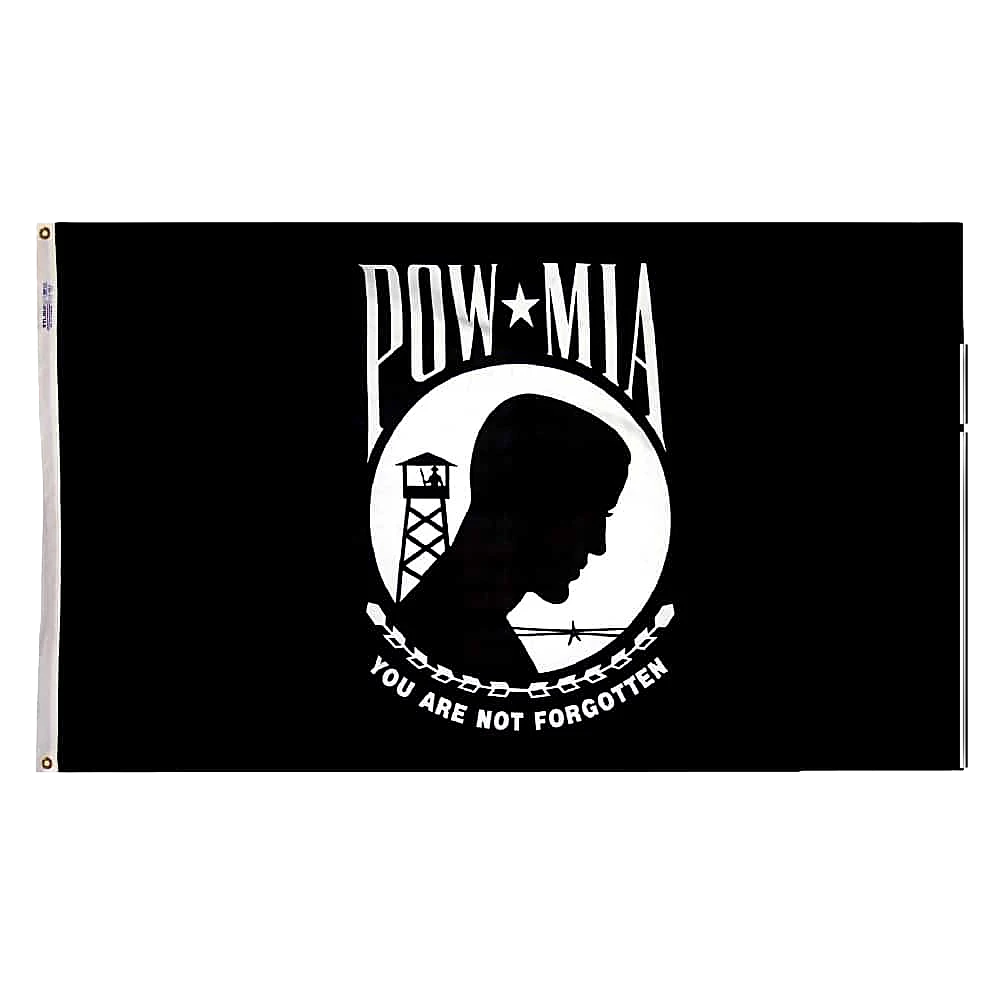
Search for POW/MIA flag rules and you will find page after page listing six days: Armed Forces Day, Memorial Day, Flag Day, Independence Day, National POW/MIA Recognition Day, and Veterans Day.
That list is out of date.
The National POW/MIA Flag Act, Public Law 116-67, signed November 7, 2019, rewrote 36 U.S.C. §902. The statute now requires the POW/MIA flag to be displayed on all days on which the flag of the United States is displayed, not on a short list of days.
It also names where. The Capitol. The White House. The World War II Memorial, the Korean War Veterans Memorial, and the Vietnam Veterans Memorial. Each national cemetery. The buildings holding the offices of the Secretary of State, the Secretary of Defense, the Secretary of Veterans Affairs, and the Director of the Selective Service System. Each major military installation as designated by the Secretary of Defense. Each Department of Veterans Affairs medical center. And each United States Postal Service post office. The law adds that the display must be in a manner designed to ensure visibility to the public.

If you handle flags for any of those, the obligation is daily, not annual. If you do not, the six-day list is still a perfectly reasonable schedule for a private pole, and Veterans Day is on it either way.
Where the POW/MIA Flag Goes

The short answer: the statute does not say.
36 U.S.C. §902 requires the display and names the locations. It does not specify position on a staff. Neither does the Flag Code, which never mentions the POW/MIA flag at all.
What exists is settled custom, and it is consistent enough to rely on. On a single halyard the POW/MIA flag flies immediately beneath the United States flag and above any other flag on that staff. On separate poles it goes to the US flag’s own left, which is the viewer’s right. That is the same position state and other flags take.
The one rule that is not custom is the one underneath it all. Under 4 U.S.C. §7(c), no other flag should be placed above the United States flag, or to its own right (the viewer’s left), on American soil. The POW/MIA flag is not an exception, and neither is a service flag.
Service Flag Order

Veterans Day is the day organizations reach for the six service flags, and it is also the day the order gets scrambled.
The order of precedence for the armed forces runs Army, Marine Corps, Navy, Air Force, Space Force, Coast Guard.
The order does not follow founding dates. The Navy dates to October 13, 1775, almost a month before the Marine Corps on November 10, 1775. The Marines have ranked ahead since 1921, when the Navy still dated its founding to the 1790s. The Navy adopted its 1775 birthday in 1972, and the order never changed.
The Coast Guard carries an exception worth knowing. In peacetime it sits last. When the Coast Guard operates as part of the Navy in time of war, its flag moves up to follow the Navy and precede the Air Force.
Our full breakdown, including where state, city, organizational, and POW/MIA flags fall, is in the guide to the flag order of precedence.
Veterans Day Flag Checklist
- Full staff. The US flag sits at the peak of the pole, all day. No noon change, no half-staff.
- Sunrise to sunset, unless lit. The 24 hour display in 4 U.S.C. §6(a) requires proper illumination during darkness.
- Check the flag before it goes up. November weather finds every weak seam. A flag with a frayed fly end or a faded canton is the wrong flag for this particular day.
- Nothing above the US flag. Not the POW/MIA flag, not a service flag, not a state flag.
- Same size, same height, if you fly more than one nation. Separate staffs of the same height, flags of approximately equal size, per 4 U.S.C. §7(g).
- Retire what is worn out. A flag no longer fit for display should be destroyed in a dignified way, preferably by burning, under 4 U.S.C. §8(k). We cover how that is done, and what we handle, on our flag repair and disposal page.
Common questions
Related reading
Sources
- 4 U.S.C. §6, Time and occasions for display · uscode.house.gov
- 4 U.S.C. §7, Position and manner of display · uscode.house.gov
- 36 U.S.C. §902, National League of Families POW/MIA flag · uscode.house.gov
- National POW/MIA Flag Act, Public Law 116-67 (Nov 7, 2019) · govinfo.gov
- History of Veterans Day · department.va.gov
- Who Has Precedence: Navy or Marines? · military.com
Where to Buy


- All sizes and finishes: US Flags
- Single- and double-sided styles: POW/MIA Flags
- Every branch: Military Flags


