
On this page
The historical flags of the United States begin long before the Stars and Stripes. Ten of them are below, in the order they appeared. Each one flew over some part of what became the United States, or was carried by the people who fought to make it one. Where a popular story does not hold up against the record, this page says so. Several of these historical flags are still made and flown today.
Before independence
The earliest historical flags of the United States were not American. They were English and British, and colonists flew them for more than a century and a half. All three appear again, in part, in the historical flags that followed.

St. George’s Cross
A red cross on a white field. The emblem of England, associated with Richard I during the Crusades in the 1190s and carried by English explorers to North America. It is the oldest element in the family of flags on this page, and it survives today inside the Union Flag.
A date of 1277 is sometimes given for its adoption. No authoritative source supports that year, so it is not repeated here.

King’s Colors
The first Union Flag, ordered by James I on April 12, 1606, after he inherited the English crown and joined it to Scotland’s. It lays the red cross of St. George over the white saltire of St. Andrew on blue. The red saltire of St. Patrick was not added until 1801.
This is the flag British troops carried in the colonies through the 1700s, and it is the canton of two flags further down this page.

British Red Ensign
A red field with the Union Flag in the upper hoist corner. Established in 1707 for British merchant ships after the Acts of Union, and widely flown in the colonies before the Revolution. It was the official flag of the Colony of Massachusetts.
It is often called Queen Anne’s Flag, after the monarch in 1707.
The Revolution
The war years produced the most recognizable historical flags on this list, and the most argued over. Several of the stories attached to them were written down long after the fighting stopped.

Continental Flag
A red field with a white canton bearing a green pine tree. The pine was a New England symbol long before the war. Flags of this family were used by Massachusetts forces in 1775, and a pine tree ensign flew on the cruisers George Washington commissioned that autumn.
The link to Bunker Hill rests mostly on John Trumbull’s painting of the battle, made eleven years later by an artist who was not there. The National Park Service notes that eyewitness accounts of which flag flew at the redoubt contradict each other.

Gadsden Flag
A coiled rattlesnake on a yellow field, above the words Dont Tread On Me. Named for Christopher Gadsden of South Carolina, who presented the design in late 1775 and early 1776. Commodore Esek Hopkins flew it as his personal standard as the first commander of the Continental Navy.
It is well documented as Hopkins’s own flag. It is not documented as the Navy’s official jack, which his own orders describe only as a striped jack.

Grand Union Flag
Thirteen red and white stripes with the Union Flag in the canton. Also called the Continental Colors or the Cambridge Flag. It served as the unofficial national flag from late 1775 until the Flag Resolution of June 14, 1777.
The earliest documented flying is aboard Hopkins’s flagship Alfred on the Delaware River, December 3, 1775. The familiar story of Washington raising it at Prospect Hill on January 1, 1776 is the traditional account, and most historians accept it, but the record is not settled on which flag went up that day.
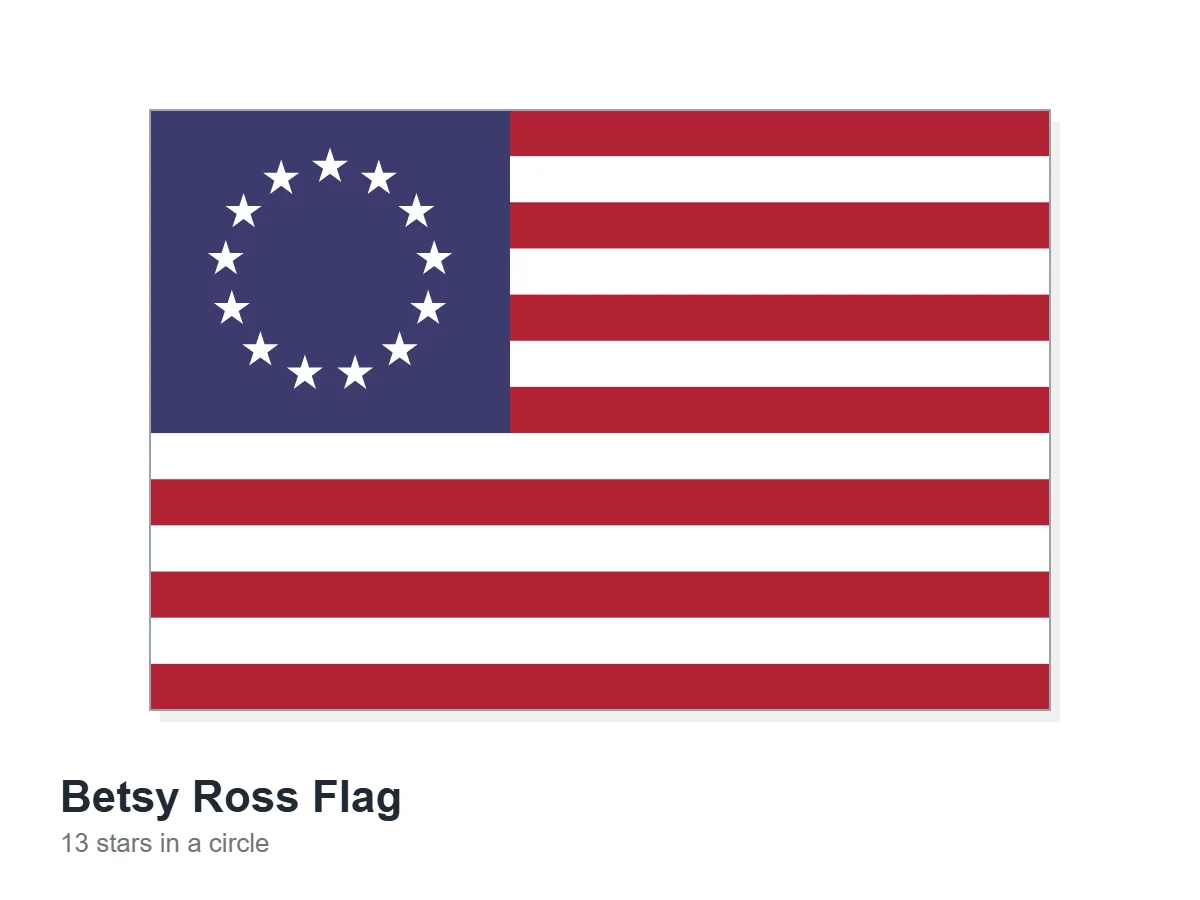
Betsy Ross Flag
Thirteen stripes and thirteen white stars in a circle on blue. The design is real and popular. The story behind it is not documented.
Betsy Ross was a Philadelphia flagmaker with a paid contract to make flags for the Pennsylvania Navy. The account of her sewing the first Stars and Stripes for George Washington in 1776 was first told publicly by her grandson in 1870, nearly a century later, and no contemporary record supports it. Circular thirteen-star flags are better attested from the 1790s than from the Revolution.

Bennington Flag
Seven white and six red stripes, so the outer stripes are white, with a blue canton holding a large 76 under an arch of eleven stars and two more in the upper corners. Tradition ties it to the Battle of Bennington on August 16, 1777.
The official House of Representatives history of the flag states that it was probably made for the fiftieth anniversary of independence in 1826, not carried in the war. The flag associated with the name is held by the Bennington Museum in Vermont.
The Republic
Two historical flags close out the story. One flew over Fort McHenry in 1814. The other is on poles across the country today.

Star-Spangled Banner
Fifteen stars and fifteen stripes, one of each for every state in the Union after Vermont and Kentucky joined. This is the only official United States flag with more than thirteen stripes, set by the Flag Act of 1794 and in use from May 1, 1795 to July 3, 1818.
The flag that flew over Fort McHenry during the British bombardment of September 13 and 14, 1814 was sewn by Mary Pickersgill in Baltimore, measured thirty by forty-two feet, and inspired Francis Scott Key’s verses. It is at the Smithsonian’s National Museum of American History.

The 50-Star Flag
Thirteen stripes and fifty stars in nine staggered rows. Prescribed by Executive Order 10834 on August 21, 1959, after Alaska and Hawaii were admitted, and official since July 4, 1960. It is the longest-serving design in the flag’s history. It is also the last of the historical flags of the United States, and the only one still official.
The story that an Ohio high school student, Robert Heft, designed it as a class project is widely repeated. The Eisenhower Presidential Library’s account of the selection describes a government design committee working through more than three thousand public submissions, and does not mention him. Treat the story as unconfirmed.
The Three Flag Acts
Three decisions in Congress fixed the design. They are the legal record behind the historical flags of the United States above.
June 14, 1777. The Continental Congress resolved that the flag be thirteen stripes, alternate red and white, with a union of thirteen white stars on a blue field. This is why Flag Day is June 14.
January 13, 1794. Congress raised the count to fifteen stars and fifteen stripes, effective May 1, 1795, for Vermont and Kentucky.
April 4, 1818. Congress fixed the stripes at thirteen for the original colonies and set the rule still in force: one star for each state, added on the July 4 following admission.
Every one of the historical flags above sits on one side or the other of these three dates.
Related reading
Where to buy historical flags of the United States
We carry the historical flags of the United States on this page in sewn and printed versions. Browse them under historical flags, alongside the current US flag in every standard size. For a ceremony, a classroom, or a display, tell us the setting and we will point you to the right construction. Historical flags also display well as a set, hung in date order for a classroom wall or a lobby.
Sources
Every date and claim about these historical flags traces back to one of the following.
- Our Flag, House Document 100-247 · U.S. House of Representatives · History of the Stars and Stripes and Early American Flags
- History of the Union Flag · The Flag Institute · flaginstitute.org
- The Many Crosses of St George · The Flag Institute · flaginstitute.org
- Flags at Bunker Hill · National Park Service · nps.gov
- Prospect Hill · National Park Service · nps.gov
- The U.S. Navy’s Jack · Naval History and Heritage Command · history.navy.mil
- The Truth About Betsy Ross · Colonial Williamsburg Foundation · colonialwilliamsburg.org
- The Star-Spangled Banner · Smithsonian National Museum of American History · amhistory.si.edu
- Facts about the United States Flag · Smithsonian Institution · si.edu
- Design of the 49 and 50 Star Flags · Eisenhower Presidential Library · eisenhowerlibrary.gov
- Executive Order 10834 · National Archives · archives.gov


Leave A Comment