
On this page
- Two Battalions and a Tavern
- A Birthday Order, Read Aloud Since 1921
- Three Slices in a Fixed Order
- Scarlet and Gold Since 1925
- The Flag That Never Comes Down
- Second in Line, Even on Its Birthday
- The Emblem Comes With a License
- Before You Fly a Flag for the Marine Corps Birthday
- Common questions
- Related reading
- Sources
- Where to Buy
Tuesday, November 10, 2026, is the Marine Corps birthday, the 251st. Fly the United States flag at full staff, sunrise to sunset, and if you fly the scarlet Marine Corps flag with it, keep it second in line behind the Army flag.
Most military anniversaries are a date and a cake. The Marine Corps birthday comes with written orders: an order read aloud every year since 1921, a cake cut in a prescribed sequence, and a flag that, by presidential proclamation, never comes down.
Two Battalions and a Tavern

On November 10, 1775, the Second Continental Congress resolved that two battalions of Marines be raised. That resolution is the birth certificate, and the Marine Corps History Division dates the Corps from it.
Samuel Nicholas was commissioned the first officer and is counted as the first Commandant. Tradition puts his recruiting at Tun Tavern in Philadelphia. The Corps took the tradition seriously enough to unveil a tablet at the tavern site in 1925 and to shape a birthday cake like the building in 1937.
Nicholas’s battalion made the first Marine landing in March 1776, a raid on New Providence in the Bahamas. The Continental Marines were disbanded after the Revolution, and Congress brought the Corps back on July 11, 1798, when President Adams signed the act re-establishing it.
That second date matters, because for 123 years it was the Marine Corps birthday.
A Birthday Order, Read Aloud Since 1921
From 1798 until 1921 the Marine Corps birthday was July 11, the date of the 1798 act, and the Corps marked it quietly. A 1918 clipping notes the 120th birthday passing on July 11 as usual, with no fuss.
Then a historian intervened. On October 21, 1921, Major Edwin McClellan sent the Commandant a memo proposing that November 10, 1775, be treated as the birthday and declared a Marine Corps holiday.
Major General John A. Lejeune agreed within days. On November 1, 1921, he issued Marine Corps Order No. 47, Series 1921, and directed that it be read to every command on November 10 each year. The first formal celebration followed nine days later.
Other services mark birthdays. The Marines have a standing order to observe theirs, dated 1921, and it has been read every November 10 since. The Marine Corps birthday is a date with a script.
Three Slices in a Fixed Order
The Marine Corps birthday ball came next. The earliest record the History Division has found is 1925, in Philadelphia, the same year the Tun Tavern tablet went up.
The Marine Corps birthday cake took longer to settle. The earliest evidence of a cake ceremony is Quantico, Virginia, in 1935. In 1937 Marine Barracks, Washington, held an open house under Commandant Thomas Holcomb with a cake shaped like Tun Tavern.
On October 28, 1952, Commandant Lemuel C. Shepherd Jr. directed that the birthday be formalized and laid out the cake ceremony. His outline went into the Marine Corps Drill Manual approved on January 26, 1956, and the sequence has barely moved since.
The official script keeps three slices in order. The first piece goes to the guest of honor. The second goes to the oldest Marine present, who hands it to the youngest Marine present. The passing of the cake is the whole point: experience handed to the newest Marine in the room, in front of everyone. The cake is cut with a Mameluke sword, the officer’s sword modeled on the one Lieutenant Presley O’Bannon is said to have been given after Derna in 1805.
The Marine Corps publishes the script and says plainly that there is no single set-in-stone version. The order of the slices is the constant.
Scarlet and Gold Since 1925

For its first 150 years the Corps carried whatever flag the moment supplied. Nicholas’s Marines probably went ashore in the Bahamas under the Grand Union flag. In the 1830s and 1840s the standard was white with gold fringe, an eagle and an anchor, and a motto that read To the Shores of Tripoli until the Mexican War added the Halls of the Montezumas. From 1876 Marines carried the national colors with U.S. Marine Corps embroidered in yellow across the center stripe. The 1914 landing at Vera Cruz went in under a blue standard.
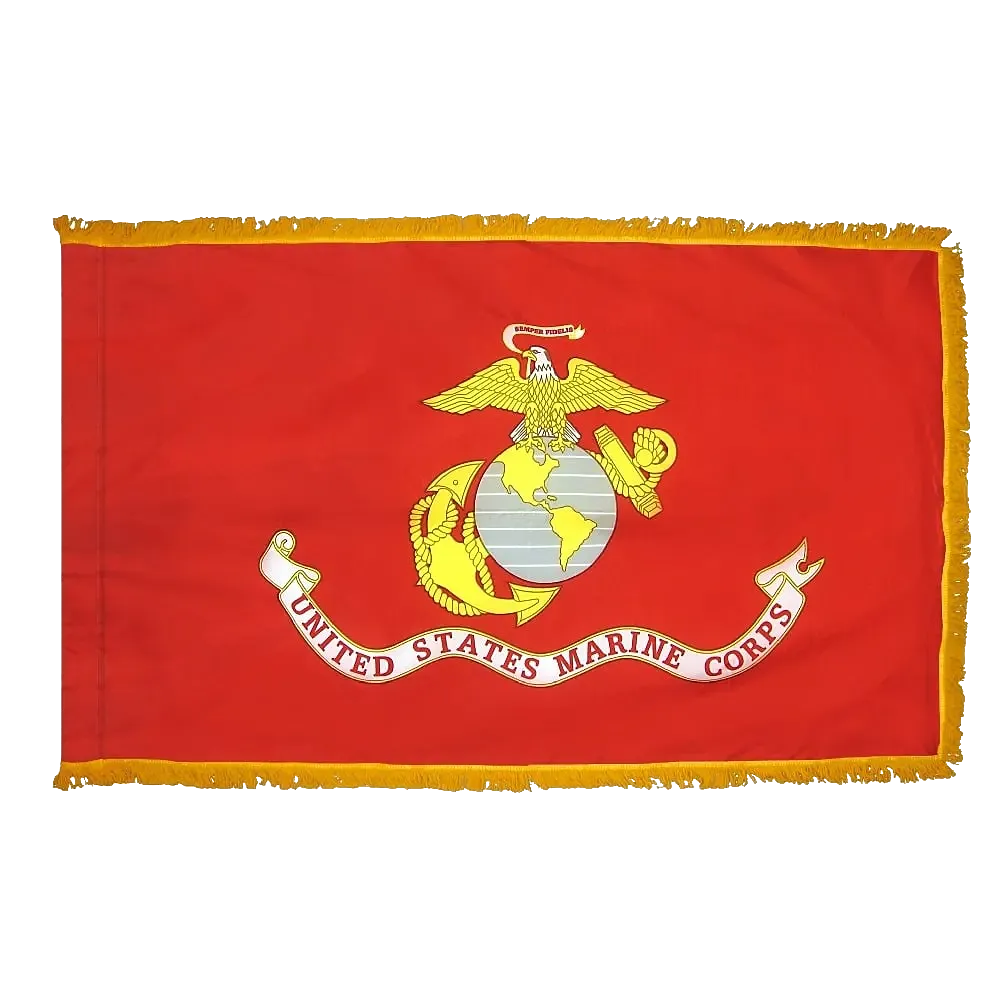
Marine Corps Order No. 4 of April 18, 1925, made scarlet and gold the official colors. The design on today’s flag, a scarlet field carrying the eagle, globe and anchor in gray and gold above a scroll reading United States Marine Corps, was approved on January 18, 1939.
The same year settled the battle honors. Until then they had been embroidered straight onto the colors, which ran out of room after the First World War. Marine Corps Order No. 157 of November 3, 1939, adopted the Army’s system of streamers hung from the staff instead. The official Battle Color of the Marine Corps, kept at Marine Barracks, Washington, with a duplicate in the Commandant’s office at the Pentagon, now carries some fifty of them.
If you buy a Marine Corps flag for a Marine Corps birthday ball or ceremony, it carries gold fringe. Outdoors it flies plain, with a pole hem or grommets, because fringe does not survive weather.
The Flag That Never Comes Down

On February 23, 1945, Associated Press photographer Joe Rosenthal caught six Marines raising the second, larger flag on Mount Suribachi, Iwo Jima. Felix W. de Weldon, then on duty with the Navy, turned the photograph into bronze. The figures stand 32 FT tall and raise a 60 FT flagpole; the whole memorial rises about 78 FT.
President Eisenhower dedicated the Marine Corps War Memorial in Arlington, Virginia, on November 10, 1954. The date was not a coincidence. It was the 179th Marine Corps birthday.
Then came the flag rule. The Flag Code’s general custom is sunrise to sunset unless the flag is lit. On June 12, 1961, President Kennedy signed Proclamation 3418, directing that the United States flag be displayed at the memorial at all times, day and night, except in inclement weather. It is one of a handful of places in the country where the flag flies around the clock by name, under its own proclamation rather than under the general lighting exception.
So the most photographed flag-raising in American history is now a flag that is never lowered. A gold ring around the granite base lists every principal Marine Corps engagement since 1775.
Second in Line, Even on Its Birthday

The Flag Code does not know about November 10. The list of display days in 4 U.S.C. §6(d) runs from New Year’s Day to Christmas and names Armed Forces Day, Navy Day, and Veterans Day, but no service birthday. The flag may be displayed every day, so flying it for the Marine Corps birthday is proper. It is simply not required.
Two rules do apply, and both are easy to break in a burst of enthusiasm.
First, nothing goes above the United States flag or to its own right on American soil, under 4 U.S.C. §7(c). The scarlet flag does not take the position of honor on its birthday. No service flag ever does.
Second, the order of precedence among the service flags does not change for the occasion. It runs Army, Marine Corps, Navy, Air Force, Space Force, Coast Guard. The Marine Corps flag is second in line on November 10 exactly as it is on every other day. The Marines have ranked ahead of the Navy since 1921, when the Navy still dated its own founding to the 1790s, and the order held when the Navy adopted its 1775 birthday in 1972. We cover that history in our Navy Day post. Our guide to the flag order of precedence covers the full lineup, including state and POW/MIA flags.
There is one piece of good timing. The Marine Corps birthday falls on November 10 and Veterans Day on November 11, which is a display day in 4 U.S.C. §6(d). A United States flag raised to the peak for the Marines on Tuesday is already set correctly for Wednesday. Leave it up, lit if it stays out overnight, and you have observed both days with one halyard.
The Emblem Comes With a License

The emblem on that flag is also a registered mark, which matters to anyone ordering a custom flag or banner for November 10.
The eagle, globe and anchor is not public property. Under 10 U.S.C. §8921, the Marine Corps seal, emblem, name, and the initials USMC are protected, and the Marine Corps Trademark Licensing Office treats the words Marine Corps, Marines, and The Few. The Proud. as its marks too. Anyone who makes or sells goods carrying them needs a license agreement first. Royalties go back to the licensing program and to morale, welfare, and recreation programs for Marines.
The office draws a sensible line for individuals. Current and former Marines, Defense Department employees, and their families may put the emblem on personal items that are not for sale: a banner for a homecoming, a cake, invitations, a shirt. A family may put the emblem on a headstone. What nobody may do without a license is sell it.
A unit ordering a banner for its own ball is one of the limited cases the office allows. A shop that prints the emblem for sale needs a license of its own. If you are ordering custom work for the Marine Corps birthday, settle that question before the artwork, not after.
Before You Fly a Flag for the Marine Corps Birthday

- Full staff. The United States flag at the peak, sunrise to sunset, or around the clock if it is lit. Nothing in the Flag Code or in any proclamation lowers it for the Marine Corps birthday.
- United States flag first. On a single halyard the Marine Corps flag flies beneath it. On separate poles the US flag takes the position of honor, its own right, which is the viewer’s left.
- Second among the services. If the Army flag is in the lineup, the Marine Corps flag follows it. Army, Marine Corps, Navy, Air Force, Space Force, Coast Guard.
- Fringe indoors, plain outdoors. Gold fringe belongs on the parade and ceremony flag. The outdoor flag flies with a pole hem or grommets.
- Check the scarlet before it goes up. Scarlet is unforgiving of fading. A pink Marine Corps flag on November 10 is the wrong flag for the day. Our flag repair and disposal page covers when to retire one.
- Leave it up for Veterans Day. November 11 is a display day. A flag raised correctly on the Marine Corps birthday is correct on the 11th.
Common questions
Related reading
Sources
- History of the Marine Corps Birthday Celebration, USMC History Division material · military.com
- Marine Corps Birthday Cake Cutting Script · marines.mil
- Historical Documents, Orders and Speeches (MCO No. 47, MCO No. 4) · usmcu.edu
- Battle Colors of the Marine Corps · usmcu.edu
- Marine Corps History: The Marine Flag · military.com
- U.S. Marine Corps War Memorial · nps.gov
- Proclamation 3418 of June 12, 1961, Display of the flag at the United States Marine Corps Memorial · archives.gov
- 4 U.S.C. §6, Time and occasions for display · uscode.house.gov
- 4 U.S.C. §7, Position and manner of display · uscode.house.gov
- Marine Corps Trademark Licensing Office, Frequently Asked Questions · trademark.marines.mil
- Who Has Precedence: Navy or Marines? · military.com
Where to Buy


- All sizes and finishes: US Flags
- Grommet, pole hem, and fringe styles: Marine Corps Flags
- Every branch in order: Military Flags


Leave A Comment